In the beginning, there were only professors and students, and relations between them were very simple. A student would give the professor half of the fee for a course at the first class, and the remainder after the last class. A few poorer students, who could not pay the full amount in cash, would sometimes bring vegetables they had grown, or a fish they had caught, and the professors accepted these graciously. The widow of a former mathematics professor pickled the vegetables and salted the fish before distributing them among the faculty.
As the college grew, so did its reputation, and as more classes were needed, more professors came to teach. To make things easier for the professors, the widow began collecting the fees and depositing them at the local bank. She also began keeping simple records. At some point, no-one could remember exactly when, the professors agreed among themselves to pay her a stipend for the services she provided.
Showing posts with label academia. Show all posts
Showing posts with label academia. Show all posts
Monday, January 15, 2018
Administrators
Administrators - a parable after Kafkaby Emrys Westacott


Monday, November 20, 2017
Personal Statements
Harry Brighouse gives good advice on writing personal statements for graduate school applications. In short, he observes that personal statements are rarely if ever decisive for acceptance. So don't spend too much time on it, it's all right to be ordinary, and just answer the questions.
In philosophy the main purpose of the personal statement is to convey that you know what you are doing, that you are genuinely interested in the program you’re applying to, and that you are not a complete flake.
Saturday, July 29, 2017
Actual examples of "censorship"
tl;dr: I do not at all support the freedom for anyone in academia to say racist stuff. Academia is a complicated environment with a variety of specialized functions; these circumstances make even a no-government-censorship comparison — much less a "free speech means I can say whatever I want wherever and whenever I want" comparison — completely inapt. Fredrik deBoer's article, Yes, Campus Activists Have Attempted to Censor Completely Mainstream Views, basically argues for a free speech right to be a racist asshole on a college campus, harassing, excluding, and marginalizing students of students of color, so long as that harassment is entirely verbal (or a "speech act", like painting a swastika out of feces). I can't think of a more egregious example of a leftist being a bourgeois stooge.
* * *
I'm about to begin my eighth year in academia. We in academia like to think of ourselves as objective seekers after the truth, unafraid to address even the most morally challenging issues and ideas, but even for the most honest and careful, it's never that simple. All research projects, even the physical sciences, are bound up in a lot of social constructions: what to investigate, who gets to investigate it, how it's investigated, and, crucially, how investigation affects the participants' status. In addition to being an institution (meta-institution) that engages in the objective search for truth, academia as an institution confers status, making it possible (or much more likely) for students and professors to achieve social positions of relative power, importance, and wealth. Finally, the university is not ideologically neutral: the university exercises substantial influence on the social legitimation and delegitimation of ideas.
Even a single university is also one of the most complicated coherent institution I've seen. Multinational corporations are larger, but they use a rigid authoritarian hierarchy to manage that size. Universities by their nature cannot employ this strategy. Universities do, of course, employ authority and hierarchy, but nowhere near to the degree of large corporations: a university cannot just tell a professor or student, "Do this task this way or you're fired." A university brings together scores or hundreds of faculty and hundreds or thousands of students, all of whom are pursuing interests of the utmost seriousness and making substantial commitments of time, and for the students, a lot of money. I lived in a commune of only about 30 people, and just reproducing the institution on a daily basis was an exhausting chore; trying to manage the interests, goals, preferences, and desires of thousands of people trying to do something they consider extremely important presents enormous challenges.
The notion of "free speech" and "censorship" is itself complicated. Just the most fundamental sense of the whether government may impose criminal or civil penalties for speech has generated entire specialties of legal scholarship and jurisprudence. What qualifies as "speech"? Under what circumstances can the government engage in censorship? What specifically justifies categorizing this as speech and that as action, and what justifies this censorship and not that? Just to address one narrow component of these questions requires a PhD thesis or a hundred-page Supreme Court decision. Trying to decide what constitutes "free speech" and "censorship" when we're considering the actions of people outside the government is a thousand times more complicated. When does criticism become censorship? When does expressing an opinion become harassment or oppression? How do we explore these questions when people are stuck with each other, when their relationship is fundamentally non-transactional? We cannot simply declare "free speech!" and automatically gain the moral high ground.
We also live under a system with profound privilege and power for Christian, white, male, heterosexual, and cis-gendered people. Members of other religion (or no religion), people of color, especially the descendants of black chattel slavery, women, queer people and people who do not conform to conventional gender norms have for centuries been marginalized, exploited, oppressed, assaulted, and murdered, often in genocidal quantities. The only "objective" questions are whether there is such social privilege, and whether those with social privilege have marginalized, etc. those without it. These objective questions has been answered decisively in the affirmative; to deny these manifest truths is akin to arguing a flat earth. Either you believe this oppression is good, and should be perpetuated, or it is bad, and should be eliminated, root and branch. There is no middle moral position, only arguments over tactics.
If a college professor teaches the flat earth in geology class, if they teach Intelligent Design in biology class, if they teach that vaccines cause autism in medical school, that professor should be fired. For their ideas. If that's "censorship", I'm OK with that.
When we were living together, my (now ex) girlfriend came home absolutely livid. She is black, and her (white, duh) professor told her straight to her face that black people can't learn math. She complained to the head of the department, and he was later gone. Is that censorship? Even if it is, I will say straight out, I'm perfectly OK with that sort of censorship. It was not only wrong, it was oppressive and harmful.
Recently, one of the math professors used an egregiously sexist metaphor in his class. The professor was forced to apologize; I believe the apology was actually sincere, but that's not the point: sincere or not, he had to make it, he had to make it good, or he would have been out on his ass. Again, I will say I'm fine that he was forced to apologize.
I am not, however, saying that anyone in the university — administration, faculty, or students — should have or seek the power to arbitrarily censor anything they don't like. I tutor freshman composition, and I have helped students write papers denying global warming, opposing vaccination, endorsing the hijab, arguing for creationism, and any number of ideas I disagree with. I don't want to tell them their ideas are wrong (my job is to get them to learn how to argue, and (sadly) how to craft grammatical sentences and coherent paragraphs), but even if I didn't think so, I am (as, I think, are their professors) obligated not to tell them that they're wrong and not to write about something else. One important component is that freshman have very little power, and a freshman comp paper will typically not be read by anyone other than the professor, so its potential harm is extremely low.
My point is that we have to think carefully about speech on campus, and not just shout, "Free Speech!" We have to look carefully at the effects of speech, and how this or that speech fits with the institutional constraints and goals of academia.
I do have a few principles more fundamental than free speech (in the sense that people should be able to say whatever they want without any kind of coercive social sanction). First, racism — by which I mean anything that is both false, stupid, or normative and that endorses, perpetuates, legitimizes, or erases the documented, proven oppression of people of color by white Europeans — has no place in academia. Period. People in academia should not say anything even a little bit racist. The government should not fine or imprison anyone or subject them to civil penalty for saying even egregiously racist things, but racists' protection ends there. No academic should ever express any racist idea.
And not just on campus. Both professors and students are public intellectuals, which confers special importance on what they say in public. If a freshman student even tweets a racist joke from home, they have no place in academia: they need to apologize and correct their behavior or go someplace that is not in the business of credentialing intellectual competence. If that is censorship, I'm openly, directly, and completely in favor. And if you're against that sort of censorship, well, I have to ask: what do we gain by legitimizing and normalizing — especially in an institution that proclaims its role at certifying intellectual competence — any sort of speech that perpetuates oppression?
So too with (just off the top of my head) sexism, hetero-normativity, cis-gender-normativity, and religious discrimination. As public intellectuals, academics have zero business perpetuating these evils. I don't care what you really believe; I just want you to shut up about them or get the fuck out of my university.
Sorry for the long-winded introduction to what will be an even longer post. I just want to make my position crystal clear.
* * *
On the one hand, bless you, Fredrik deBoer: in his essay, Yes, Campus Activists Have Attempted to Censor Completely Mainstream Views, he provides actual examples with links of the kind of behavior he considers objectionable censorship. For context, deBoer is a self-identified leftist, with a PhD in (IIRC) English composition instruction. (He's also a pretty good statistician.) On the other hand, I don't think his argument or examples are very good.
Just his claim is highly problematic in itself:
I absolutely despise the "impression" claim. This is pure concern trolling. Are these incidents actually creating anti-conservative bias, or are they just creating some "impression". Look, people have gotten the "impression" that I endorse the starvation of millions of people (I have been called both a Stalinist and a Maoist with precisely this implication) because I support a communist state, and not some infantile anarchist utopia. I am just not responsible for people's impressions that are not supported by the actual content of what I say. If you want to argue the fact, argue the fact, not impressions (which are probably self-serving and stupid) about the fact.
deBoer also makes a causal fallacy (For an excellent introduction to causal fallacies, see Siggy's excellent post, Trump’s Past Light Cone.) I agree that Republicans are fighting academia, and it is probably true that there is some impression of anti-conservative bias in academia, but the causal connection is unproven. As a competent statistician, deBoer should at least try to exclude reverse causality: perhaps the incidents that create the "impressions" are the result of, not the cause of, Republican opposition. There could also be other, unmeasured, causes influencing the connection (what we econometricians and statisticians call omitted variable bias). One hypothesis is that the professional-managerial class took state power from the capitalist class, but made a fatal mistake: they did not destroy the capitalist class as a class. The capitalist class regained state power, and they do not intend to make the same mistake: they want to annihilate the professional-managerial class and plow salt in their fields. The university, as the foundation of professional-managerial class legitimacy, is their most important target. Just deBoer's claim is a variant on the argument that leftist intransigence somehow created the racist alt-right, an argument that JMP demolishes in The Alt-Right Was Not A Response To Some "Alt-Left".
deBoer also conflates partisanship with ideology. (If he simply claims that Republicans conflate party and ideology, well duh. Of course they would.) As an employee of a public university and a public community college, I am required to be nonpartisan only in the sense that I am not allowed to endorse or condemn specific candidates, political parties, or ballot measures during an election. That doesn't mean that I have to be ideologically neutral (whatever that means). I can be for good ideas and against bad ideas. Indeed, academia as a whole cannot be even as ideologically neutral as the math department (and math has its own ideological norms). Academia is in the business of conferring or denying ideological legitimacy.
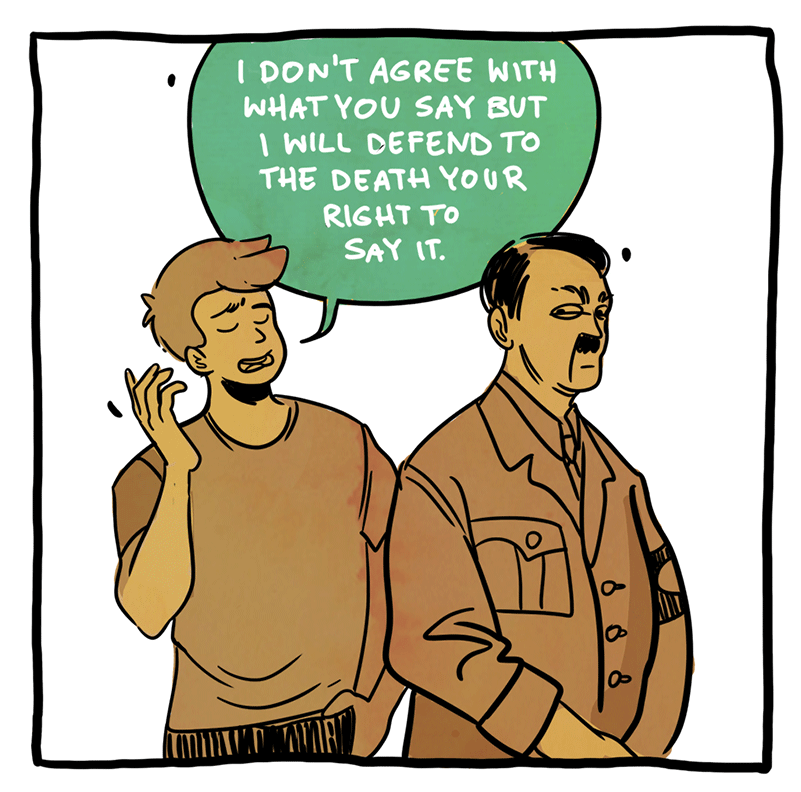
Even granting the most charitable possible interpretation of his argument, i.e. the noted incidents really do create "anti-conservative bias" (and not just some "impression"), and this impression really is the most important or dominant cause of the "collapse of Republican support" for academia, it does not then follow that we should refrain from these incidents. Much depends on what deBoer means by conservatism. If conservatism really does mean just the perpetuation of the white Christian patriarchy, with rigid sex and gender essentialism and norms, then academia shouldn't just have a bias against conservatism, we should be fighting conservatism tooth and nail, and not whinging when the racists, etc. fight back. It doesn't matter how much power theconservatives racists Republicans have: we won't undermine that power by not putting teeth in our demands.
On to the examples. (Links are original.) There are a lot, so this will take a while.
Student activists at Amherst University demanded that students who had criticized their protests be formally punished by the university and forced to attend sensitivity training.
This is not an original source; neither deBoer nor Katie Zavadski, the author of the linked Daily Beast article, link to the students' demands. However, the article does quote one demand, "that President Biddy Martin issue a statement saying that Amherst does 'not tolerate the actions of student(s) who posted the "All Lives Matter" posters, and the "Free Speech" posters.'” "All Lives Matter" is facially racist; according to Zavadski, the "Free Speech" posters are related to Robby Soave's article, Students: Fight Racism, Not Free Speech, which seems to defend the rights of "a random jerk in a truck shouting racial slurs at Mizzou’s black student body president and [those who created] a swastika made of feces appearing on the wall of a residence building." Color me censorious, but I'm 100 percent with the Amherst students.
At Oberlin, students made a formal demand that specific professors and administrators be fired because the students did not like their politics.
The formal demand appears in a 14 page manifesto, alleging pervasive and egregious racism at Oberlin. Presumably, deBoer refers to this specific demand on p. 12, reproduced in full (I cannot copy and paste; I apologize for any errors in transcription):
So basically, the students are demanding that administrators be fired for racist incompetence, and professors for just being racists. Although their punctuation is atrocious, I'm with the Oberlin students.
"The Evergreen State College imbroglio involved students attempting to have a professor fired for criticizing one of their political actions."
This is a little more gray. But the students who are demanding Professor Weinstein be fired not because he criticized their political action (asking white students instead of minority students to observe the Day of Absence) but because they saw his criticism as specifically racist in character. I'll take the professor's side on this one, at least tepidly: I don't think professors should have the freedom to say racist things, but I don't think he said anything actually racist; if he had, he should be fired.
At Wesleyan, campus activists attempted to have the campus newspaper defunded for running a mainstream conservative editorial.
Neither the article nor deBoer link to the offending Argus article; I assume they mean Bryan Stascavage's September 14, 2015 article, Why Black Lives Matter Isn’t What You Think, which seems pretty fucking racist.
Regardless, there is not now nor has there ever been a free speech right to funding anywhere. This issue is about whether the student government has a right to control its own money.
A Dean at Claremont McKenna resigned following student backlash to an email she sent in response to complaints about the treatment of students of color.
God damn, but saying that minority student's "don't fit the C.M.C. [Claremont McKenna College] mold" seems just a wee bit racist for the president of the college.
The trend seems clear. Maybe I'll get to the rest later, but I suspect they'll all be the same.
I do not believe that anyone — student, staff, faculty, administration — has a "free speech" right to be a racist, sexist, etc. on campus. If you're fighting for this right, you're fighting to let racist, sexist, etc. conservatives violate the rights — including the free speech rights — of people of color, women, etc. The question is not whether we support this or that rights, but whose rights we support: the bigots' or the victims.
I'm about to begin my eighth year in academia. We in academia like to think of ourselves as objective seekers after the truth, unafraid to address even the most morally challenging issues and ideas, but even for the most honest and careful, it's never that simple. All research projects, even the physical sciences, are bound up in a lot of social constructions: what to investigate, who gets to investigate it, how it's investigated, and, crucially, how investigation affects the participants' status. In addition to being an institution (meta-institution) that engages in the objective search for truth, academia as an institution confers status, making it possible (or much more likely) for students and professors to achieve social positions of relative power, importance, and wealth. Finally, the university is not ideologically neutral: the university exercises substantial influence on the social legitimation and delegitimation of ideas.
Even a single university is also one of the most complicated coherent institution I've seen. Multinational corporations are larger, but they use a rigid authoritarian hierarchy to manage that size. Universities by their nature cannot employ this strategy. Universities do, of course, employ authority and hierarchy, but nowhere near to the degree of large corporations: a university cannot just tell a professor or student, "Do this task this way or you're fired." A university brings together scores or hundreds of faculty and hundreds or thousands of students, all of whom are pursuing interests of the utmost seriousness and making substantial commitments of time, and for the students, a lot of money. I lived in a commune of only about 30 people, and just reproducing the institution on a daily basis was an exhausting chore; trying to manage the interests, goals, preferences, and desires of thousands of people trying to do something they consider extremely important presents enormous challenges.
The notion of "free speech" and "censorship" is itself complicated. Just the most fundamental sense of the whether government may impose criminal or civil penalties for speech has generated entire specialties of legal scholarship and jurisprudence. What qualifies as "speech"? Under what circumstances can the government engage in censorship? What specifically justifies categorizing this as speech and that as action, and what justifies this censorship and not that? Just to address one narrow component of these questions requires a PhD thesis or a hundred-page Supreme Court decision. Trying to decide what constitutes "free speech" and "censorship" when we're considering the actions of people outside the government is a thousand times more complicated. When does criticism become censorship? When does expressing an opinion become harassment or oppression? How do we explore these questions when people are stuck with each other, when their relationship is fundamentally non-transactional? We cannot simply declare "free speech!" and automatically gain the moral high ground.
We also live under a system with profound privilege and power for Christian, white, male, heterosexual, and cis-gendered people. Members of other religion (or no religion), people of color, especially the descendants of black chattel slavery, women, queer people and people who do not conform to conventional gender norms have for centuries been marginalized, exploited, oppressed, assaulted, and murdered, often in genocidal quantities. The only "objective" questions are whether there is such social privilege, and whether those with social privilege have marginalized, etc. those without it. These objective questions has been answered decisively in the affirmative; to deny these manifest truths is akin to arguing a flat earth. Either you believe this oppression is good, and should be perpetuated, or it is bad, and should be eliminated, root and branch. There is no middle moral position, only arguments over tactics.
If a college professor teaches the flat earth in geology class, if they teach Intelligent Design in biology class, if they teach that vaccines cause autism in medical school, that professor should be fired. For their ideas. If that's "censorship", I'm OK with that.
When we were living together, my (now ex) girlfriend came home absolutely livid. She is black, and her (white, duh) professor told her straight to her face that black people can't learn math. She complained to the head of the department, and he was later gone. Is that censorship? Even if it is, I will say straight out, I'm perfectly OK with that sort of censorship. It was not only wrong, it was oppressive and harmful.
Recently, one of the math professors used an egregiously sexist metaphor in his class. The professor was forced to apologize; I believe the apology was actually sincere, but that's not the point: sincere or not, he had to make it, he had to make it good, or he would have been out on his ass. Again, I will say I'm fine that he was forced to apologize.
I am not, however, saying that anyone in the university — administration, faculty, or students — should have or seek the power to arbitrarily censor anything they don't like. I tutor freshman composition, and I have helped students write papers denying global warming, opposing vaccination, endorsing the hijab, arguing for creationism, and any number of ideas I disagree with. I don't want to tell them their ideas are wrong (my job is to get them to learn how to argue, and (sadly) how to craft grammatical sentences and coherent paragraphs), but even if I didn't think so, I am (as, I think, are their professors) obligated not to tell them that they're wrong and not to write about something else. One important component is that freshman have very little power, and a freshman comp paper will typically not be read by anyone other than the professor, so its potential harm is extremely low.
My point is that we have to think carefully about speech on campus, and not just shout, "Free Speech!" We have to look carefully at the effects of speech, and how this or that speech fits with the institutional constraints and goals of academia.
I do have a few principles more fundamental than free speech (in the sense that people should be able to say whatever they want without any kind of coercive social sanction). First, racism — by which I mean anything that is both false, stupid, or normative and that endorses, perpetuates, legitimizes, or erases the documented, proven oppression of people of color by white Europeans — has no place in academia. Period. People in academia should not say anything even a little bit racist. The government should not fine or imprison anyone or subject them to civil penalty for saying even egregiously racist things, but racists' protection ends there. No academic should ever express any racist idea.
And not just on campus. Both professors and students are public intellectuals, which confers special importance on what they say in public. If a freshman student even tweets a racist joke from home, they have no place in academia: they need to apologize and correct their behavior or go someplace that is not in the business of credentialing intellectual competence. If that is censorship, I'm openly, directly, and completely in favor. And if you're against that sort of censorship, well, I have to ask: what do we gain by legitimizing and normalizing — especially in an institution that proclaims its role at certifying intellectual competence — any sort of speech that perpetuates oppression?
So too with (just off the top of my head) sexism, hetero-normativity, cis-gender-normativity, and religious discrimination. As public intellectuals, academics have zero business perpetuating these evils. I don't care what you really believe; I just want you to shut up about them or get the fuck out of my university.
Sorry for the long-winded introduction to what will be an even longer post. I just want to make my position crystal clear.
On the one hand, bless you, Fredrik deBoer: in his essay, Yes, Campus Activists Have Attempted to Censor Completely Mainstream Views, he provides actual examples with links of the kind of behavior he considers objectionable censorship. For context, deBoer is a self-identified leftist, with a PhD in (IIRC) English composition instruction. (He's also a pretty good statistician.) On the other hand, I don't think his argument or examples are very good.
Just his claim is highly problematic in itself:
Republican support of colleges and universities has collapsed, likely because of constant incidents on campus that create a widespread impression of anti-conservative bias, and that since our public universities are chartered and funded as non-partisan institutions, and because Republicans control enormous political power, our institutions are deeply threatened. I stand by that case.
I absolutely despise the "impression" claim. This is pure concern trolling. Are these incidents actually creating anti-conservative bias, or are they just creating some "impression". Look, people have gotten the "impression" that I endorse the starvation of millions of people (I have been called both a Stalinist and a Maoist with precisely this implication) because I support a communist state, and not some infantile anarchist utopia. I am just not responsible for people's impressions that are not supported by the actual content of what I say. If you want to argue the fact, argue the fact, not impressions (which are probably self-serving and stupid) about the fact.
deBoer also makes a causal fallacy (For an excellent introduction to causal fallacies, see Siggy's excellent post, Trump’s Past Light Cone.) I agree that Republicans are fighting academia, and it is probably true that there is some impression of anti-conservative bias in academia, but the causal connection is unproven. As a competent statistician, deBoer should at least try to exclude reverse causality: perhaps the incidents that create the "impressions" are the result of, not the cause of, Republican opposition. There could also be other, unmeasured, causes influencing the connection (what we econometricians and statisticians call omitted variable bias). One hypothesis is that the professional-managerial class took state power from the capitalist class, but made a fatal mistake: they did not destroy the capitalist class as a class. The capitalist class regained state power, and they do not intend to make the same mistake: they want to annihilate the professional-managerial class and plow salt in their fields. The university, as the foundation of professional-managerial class legitimacy, is their most important target. Just deBoer's claim is a variant on the argument that leftist intransigence somehow created the racist alt-right, an argument that JMP demolishes in The Alt-Right Was Not A Response To Some "Alt-Left".
deBoer also conflates partisanship with ideology. (If he simply claims that Republicans conflate party and ideology, well duh. Of course they would.) As an employee of a public university and a public community college, I am required to be nonpartisan only in the sense that I am not allowed to endorse or condemn specific candidates, political parties, or ballot measures during an election. That doesn't mean that I have to be ideologically neutral (whatever that means). I can be for good ideas and against bad ideas. Indeed, academia as a whole cannot be even as ideologically neutral as the math department (and math has its own ideological norms). Academia is in the business of conferring or denying ideological legitimacy.
Even granting the most charitable possible interpretation of his argument, i.e. the noted incidents really do create "anti-conservative bias" (and not just some "impression"), and this impression really is the most important or dominant cause of the "collapse of Republican support" for academia, it does not then follow that we should refrain from these incidents. Much depends on what deBoer means by conservatism. If conservatism really does mean just the perpetuation of the white Christian patriarchy, with rigid sex and gender essentialism and norms, then academia shouldn't just have a bias against conservatism, we should be fighting conservatism tooth and nail, and not whinging when the racists, etc. fight back. It doesn't matter how much power the
On to the examples. (Links are original.) There are a lot, so this will take a while.
Student activists at Amherst University demanded that students who had criticized their protests be formally punished by the university and forced to attend sensitivity training.
This is not an original source; neither deBoer nor Katie Zavadski, the author of the linked Daily Beast article, link to the students' demands. However, the article does quote one demand, "that President Biddy Martin issue a statement saying that Amherst does 'not tolerate the actions of student(s) who posted the "All Lives Matter" posters, and the "Free Speech" posters.'” "All Lives Matter" is facially racist; according to Zavadski, the "Free Speech" posters are related to Robby Soave's article, Students: Fight Racism, Not Free Speech, which seems to defend the rights of "a random jerk in a truck shouting racial slurs at Mizzou’s black student body president and [those who created] a swastika made of feces appearing on the wall of a residence building." Color me censorious, but I'm 100 percent with the Amherst students.
At Oberlin, students made a formal demand that specific professors and administrators be fired because the students did not like their politics.
The formal demand appears in a 14 page manifesto, alleging pervasive and egregious racism at Oberlin. Presumably, deBoer refers to this specific demand on p. 12, reproduced in full (I cannot copy and paste; I apologize for any errors in transcription):
12. We DEMAMD the immediate firing of:
- Marjorie Burton, Head of Safety & Security for the mishandling of Black students' safety needs.
- David Alvarez, & Sergeant David Bender for their complicity and role in the violent mishandling of Zakiya Acey.
- Gerri Johnson, Accounts Payable Supervisor for their rude behavior towards Black Students and inefficient running of the office delaying the printing and releasing of checks and funds.
- Ellen Sayles, Associate Dean of Studies due to her mishandling of students [sic] mental & emotional needs.
- Kathryn Stuart, Vice President for Strategic Initiatives due to her GRAVE mishandling of the mental & emotional needs of students of color, as well as her history with the mishandling of documents that would have allowed students of color to graduate on time.
- John Harshbarger, Director of Student Health and Counseling Services for his inability to act when students of color have urgent needs and need to change their housing arrangements due to mental health concerns.
- Allen Cadwallader, Professor of Music Theory in the Conservatory, due to the racist undertones of his course as well as the ways in which he treats Black jazz students who take his course, which is rooted in white supremacy.
- Stephen Hartke Chair & Professor of the Department of Composition, for his blatantly disrespectful remarks about students [sic] pronouns, racist views on musical composition as well as his lack of effort in hiring Black composers here at Oberlin College.
So basically, the students are demanding that administrators be fired for racist incompetence, and professors for just being racists. Although their punctuation is atrocious, I'm with the Oberlin students.
"The Evergreen State College imbroglio involved students attempting to have a professor fired for criticizing one of their political actions."
This is a little more gray. But the students who are demanding Professor Weinstein be fired not because he criticized their political action (asking white students instead of minority students to observe the Day of Absence) but because they saw his criticism as specifically racist in character. I'll take the professor's side on this one, at least tepidly: I don't think professors should have the freedom to say racist things, but I don't think he said anything actually racist; if he had, he should be fired.
At Wesleyan, campus activists attempted to have the campus newspaper defunded for running a mainstream conservative editorial.
Neither the article nor deBoer link to the offending Argus article; I assume they mean Bryan Stascavage's September 14, 2015 article, Why Black Lives Matter Isn’t What You Think, which seems pretty fucking racist.
Regardless, there is not now nor has there ever been a free speech right to funding anywhere. This issue is about whether the student government has a right to control its own money.
A Dean at Claremont McKenna resigned following student backlash to an email she sent in response to complaints about the treatment of students of color.
God damn, but saying that minority student's "don't fit the C.M.C. [Claremont McKenna College] mold" seems just a wee bit racist for the president of the college.
The trend seems clear. Maybe I'll get to the rest later, but I suspect they'll all be the same.
I do not believe that anyone — student, staff, faculty, administration — has a "free speech" right to be a racist, sexist, etc. on campus. If you're fighting for this right, you're fighting to let racist, sexist, etc. conservatives violate the rights — including the free speech rights — of people of color, women, etc. The question is not whether we support this or that rights, but whose rights we support: the bigots' or the victims.
Friday, July 21, 2017
Initial thoughts on "free speech" on campus
Why is "free speech" even an issue on college campuses. A college campus is a voluntary association, and the privileges and immunities of individuals in a voluntary association are usually (but not always, see below) matters of negotiation, not right.
We could argue and negotiate about whether or not it's a Good Idea to invite, say, Charles Murray to speak on campus. A colleague, whom I admire and respect, concedes that Murray is both wrong and uses bad methodology, but that the university would be best served by openly and critically examining his ideas rather than ignoring him. I'm not sure he's wrong, but in my position as a student and faculty member, I would strongly negotiate for substantive conditions on Murray's (hypothetical) appearance: I might endorse a debate, but I would absolutely oppose Murray speaking under circumstances, such as a commencement address, that did not support critical inquiry.
But the point is not necessarily whether or not it's a good idea (and for whom it is or is not a good idea) to invite Murray to speak; the point is whether Murray has the right to speak on campus or whether my university has an obligation, separate from our already-accepted institutional obligations, to invite him to speak. Our university is a voluntary association, but the government can and does impose rights on even voluntary associations. For example, unless an association is explicitly religious, a commercial voluntary association open to the public has the state-imposed obligation to not racially discriminate; individuals have the right to attend without regard to their race, without regard to the opinions of any of the directly interested parties: even if it were the consensus of the regents, the administration, the faculty, and the student body to exclude black people, we would be legally prohibited — correctly — from permitting such discrimination. So it is not inconceivable that universities must extend some privileges and immunities as a matter of right, and not just negotiation.
However, I think the case has to be made positively that some issue is a matter of right with regard to voluntary associations; the default position, unless there are compelling reasons to the contrary, should be that an issue is a matter of negotiation.
This distinction is especially important because the U.S. Constitution explicitly makes freedom of speech a matter of right, not negotiation, with respect to federal law, and, since Gitlow v. New York, state law. NAMBLA, for example, need not justify their immunity from prosecution for publishing their views by arguing that it's a Good Idea to publish; they need only point to the First Amendment.
Thus, I'm going to be looking at what kind of arguments supposed proponents and opponents of "free speech" on campus make. It's one thing to argue that it's a Good Idea or Bad Idea to have this or that particular conversation on campus with some individual or group; it's quite another to claim that arguments against this or that conversation are irrelevant because free speech. The first is just negotiation, and as I am an interested party on only one campus, I have little to say about negotiations on other campuses except at the most abstract level.
The second, however, deserves more careful examination. First, do advocates of the right of free speech on campus assert a universal right, i.e. does everyone, or at least everyone fulfilling some objective conditions, have the right to speak on campus, or do they assert a special right, i.e. only some group (e.g. "conservatives") has the right; and other groups' privileges are subject to negotiation? On what basis do they advocate free speech? One could, of course use the First Amendment to argue a more general case, but it is insufficient to just point to the First Amendment, which restricts only federal and state law; it does not automatically extend to voluntary associations.
We could argue and negotiate about whether or not it's a Good Idea to invite, say, Charles Murray to speak on campus. A colleague, whom I admire and respect, concedes that Murray is both wrong and uses bad methodology, but that the university would be best served by openly and critically examining his ideas rather than ignoring him. I'm not sure he's wrong, but in my position as a student and faculty member, I would strongly negotiate for substantive conditions on Murray's (hypothetical) appearance: I might endorse a debate, but I would absolutely oppose Murray speaking under circumstances, such as a commencement address, that did not support critical inquiry.
But the point is not necessarily whether or not it's a good idea (and for whom it is or is not a good idea) to invite Murray to speak; the point is whether Murray has the right to speak on campus or whether my university has an obligation, separate from our already-accepted institutional obligations, to invite him to speak. Our university is a voluntary association, but the government can and does impose rights on even voluntary associations. For example, unless an association is explicitly religious, a commercial voluntary association open to the public has the state-imposed obligation to not racially discriminate; individuals have the right to attend without regard to their race, without regard to the opinions of any of the directly interested parties: even if it were the consensus of the regents, the administration, the faculty, and the student body to exclude black people, we would be legally prohibited — correctly — from permitting such discrimination. So it is not inconceivable that universities must extend some privileges and immunities as a matter of right, and not just negotiation.
However, I think the case has to be made positively that some issue is a matter of right with regard to voluntary associations; the default position, unless there are compelling reasons to the contrary, should be that an issue is a matter of negotiation.
This distinction is especially important because the U.S. Constitution explicitly makes freedom of speech a matter of right, not negotiation, with respect to federal law, and, since Gitlow v. New York, state law. NAMBLA, for example, need not justify their immunity from prosecution for publishing their views by arguing that it's a Good Idea to publish; they need only point to the First Amendment.
Thus, I'm going to be looking at what kind of arguments supposed proponents and opponents of "free speech" on campus make. It's one thing to argue that it's a Good Idea or Bad Idea to have this or that particular conversation on campus with some individual or group; it's quite another to claim that arguments against this or that conversation are irrelevant because free speech. The first is just negotiation, and as I am an interested party on only one campus, I have little to say about negotiations on other campuses except at the most abstract level.
The second, however, deserves more careful examination. First, do advocates of the right of free speech on campus assert a universal right, i.e. does everyone, or at least everyone fulfilling some objective conditions, have the right to speak on campus, or do they assert a special right, i.e. only some group (e.g. "conservatives") has the right; and other groups' privileges are subject to negotiation? On what basis do they advocate free speech? One could, of course use the First Amendment to argue a more general case, but it is insufficient to just point to the First Amendment, which restricts only federal and state law; it does not automatically extend to voluntary associations.
Saturday, June 06, 2015
Analysis of "Schlosser"
Regarding my recent post, "Professorial whining"...
In one sense, I have a little sympathy for "Schlosser." Using academic employment as a lever is, I think, a Bad Thing. Academia needs tenure. However, that the capitalist class is using students' complaints to erode tenure is not the fault of the complaining students, but the fault of the capitalist class for joining complaints to hiring and firing, and for moving from a tenure-track faculty model to a non-tenure track adjunct model. The cause, I assert, is firmly in the capitalist class; students' complaints just makes a handy tool for dismantling academic tenure and job security.
I blame academia itself too, as part of the professional-managerial class, for handing over its power to the capitalists. I will post more on this subject soon.
There's another sense, however, where I have zero sympathy for "Schlosser." When anyone increases their power vs. anyone else, we should expect that the newly more powerful will use their power in ways that the the newly less powerful will find uncomfortable, and contrary to their own ethical beliefs. Students, being closer to the proletariat, should have more power over their education. "Schlosser's" fundamental position, that students should have zero power, is absolute bullshit. With regard to the specific complaints, professors should have obligations to respect students' emotional needs. I'm not saying that that professors must unconditionally submit to those needs, but, per Thucydides, there needs to be a negotiation between parties more equal in power.
The need for equal negotiation is especially sharp when we're talking about topics and tools used to violently repress women, people of color, LBGTQ people, [ETA other historically oppressed groups,] and, of course, the proletariat. For example, the objections noted above to the Oxford debate above have merit. Abortion is not just some abstract question of ethics: restricting abortion is about the oppression of women. As mentioned above, I think having any sort of debate about abortion is as offensive to civilized decency as a debate about the chattel slavery of black people. Having two men conduct the debate just adds insult to injury.
Academia is not an institution devoted to abstract, disinterested intellectual inquiry. Academia has, from its medieval origins, ben an institution that establishes legitimacy, using particular kinds of intellectual inquiry as tools. As academics, our work is always connected to legitimacy. The underlying question is not whether some topics are too disturbing to discuss, but how how the discussion legitimizes or delegitimizes certain topics. It is legitimate (in a meta sense) to argue that the way a professor discusses, for example, rape, legitimizes rape as a tool of violent coercion against women. It's not that we cannot discuss Ovid; it is that when we're talking about Ovid's work that includes rape, not just his language but his subject matter demands critical inquiry. To blithely dismiss the subject matter of rape without critical inquiry has not Ovid (immune from our disapproval) but the professor himself legitimizing rape. In much the same sense, we can talk about Huckleberry Finn, but we have to deal critically with the slavery depicted in the book, as well as the language. How we do so legitimizes or delegitimizes not just slavery but modern racism, and it is a valid position to use one's power to ensure that our inquiry delegitimizes racism.
"Schlosser" completely ignores the role of academia in social legitimization. This omission, not just his that he actually has to take students seriously, even when he disagrees with them, is is most serious intellectual sin.
In one sense, I have a little sympathy for "Schlosser." Using academic employment as a lever is, I think, a Bad Thing. Academia needs tenure. However, that the capitalist class is using students' complaints to erode tenure is not the fault of the complaining students, but the fault of the capitalist class for joining complaints to hiring and firing, and for moving from a tenure-track faculty model to a non-tenure track adjunct model. The cause, I assert, is firmly in the capitalist class; students' complaints just makes a handy tool for dismantling academic tenure and job security.
I blame academia itself too, as part of the professional-managerial class, for handing over its power to the capitalists. I will post more on this subject soon.
There's another sense, however, where I have zero sympathy for "Schlosser." When anyone increases their power vs. anyone else, we should expect that the newly more powerful will use their power in ways that the the newly less powerful will find uncomfortable, and contrary to their own ethical beliefs. Students, being closer to the proletariat, should have more power over their education. "Schlosser's" fundamental position, that students should have zero power, is absolute bullshit. With regard to the specific complaints, professors should have obligations to respect students' emotional needs. I'm not saying that that professors must unconditionally submit to those needs, but, per Thucydides, there needs to be a negotiation between parties more equal in power.
The need for equal negotiation is especially sharp when we're talking about topics and tools used to violently repress women, people of color, LBGTQ people, [ETA other historically oppressed groups,] and, of course, the proletariat. For example, the objections noted above to the Oxford debate above have merit. Abortion is not just some abstract question of ethics: restricting abortion is about the oppression of women. As mentioned above, I think having any sort of debate about abortion is as offensive to civilized decency as a debate about the chattel slavery of black people. Having two men conduct the debate just adds insult to injury.
Academia is not an institution devoted to abstract, disinterested intellectual inquiry. Academia has, from its medieval origins, ben an institution that establishes legitimacy, using particular kinds of intellectual inquiry as tools. As academics, our work is always connected to legitimacy. The underlying question is not whether some topics are too disturbing to discuss, but how how the discussion legitimizes or delegitimizes certain topics. It is legitimate (in a meta sense) to argue that the way a professor discusses, for example, rape, legitimizes rape as a tool of violent coercion against women. It's not that we cannot discuss Ovid; it is that when we're talking about Ovid's work that includes rape, not just his language but his subject matter demands critical inquiry. To blithely dismiss the subject matter of rape without critical inquiry has not Ovid (immune from our disapproval) but the professor himself legitimizing rape. In much the same sense, we can talk about Huckleberry Finn, but we have to deal critically with the slavery depicted in the book, as well as the language. How we do so legitimizes or delegitimizes not just slavery but modern racism, and it is a valid position to use one's power to ensure that our inquiry delegitimizes racism.
"Schlosser" completely ignores the role of academia in social legitimization. This omission, not just his that he actually has to take students seriously, even when he disagrees with them, is is most serious intellectual sin.
Subscribe to:
Posts (Atom)