Showing posts with label about the blog. Show all posts

Wednesday, August 17, 2016

Civility and professionalism (yeah, right!) in internet comments

Internet comments are subject to creative conjugation: I am telling it like it is; you are abrasive; he is an asshole.

Burt Likko is unhappy with the response of several commenters on a recent (now withdrawn) post on Ordinary Times. Among other issues, Likko laments,
Toxins brew in our comments threads — seemingly forgotten is the principle of charitable interpretation, commenters labor to frame others’ statements in the worst possible light, and then demonstrate smug self-satisfaction in having done so.
Likko wishes,
This site ought to be the online equivalent of a dinner party amongst interesting friends. A college bull session, fueled by beer and fellowship and the thrill of sharing newly-learnt things. A re-creation of a symposium from classical times, where we fill each other’s wine glasses even while we debate. An environment where a multiplicity of different ideas are aired, heard, discussed, and shared. A place where people can engage in intellectual explorations, learn about new things, and try on new and different thoughts for size. For quite a while, and when the community is at its best, that’s a thrilling and exciting sort of place to be, a joyous bazaar of the mind where all manner of wares may be found on display.

I spent a few years as a contributor, moderator, and administrator of the now defunct Internet Infidels Discussion Board, as a contributor to the Straight Dope Message Board, and of course, I have this blog, so I know exactly what Likko is talking about. I've also had experience a college instructor, especially in political science. Likko wants, I think, something close to the environment I have to create in my classroom.

I could talk about rules and regulations, procedures, standards, but that's not the point. The point is to understand the attitudes and purposes of people who comment on the internet, and act to reconcile those attitudes with the desires of the publisher.

It seems too obvious, but the vibe of a dinner party between interesting friends presumes that the participants are already, you know, friends. I give my actual friends much more benefit of the doubt than I give to strangers or acquaintances. If one of my friends says something apparently dumb, I'm inclined to at least think for a moment. And even if my friend really does say something dumb, I also have an investment in the relationship, so I'll try to gently persuade them, or at least just ignore it and maintain the relationship. In contrast, if a stranger says something dumb, then I usually just write them off. There are a lot of people in the world, and I don't have time to dig into everyone's mindset to determine if they really are smart despite appearing dumb.

Second, people really really really want to be heard, and for some people, internet comments are the only way they think they can be heard. Also, everyone thinks they're right about everything (if they didn't, they would have already changed their mind), and they view contrary opinions as something wrong in need of correction. It takes enormous personal discipline to view even the best contrary opinions with charity, and even more discipline — and usually an alternative creative outlet, as I have here — to simply disengage with the worst.

The closest I've come to participating in and creating a collegiate environment among people who are not already friends is, well, in college. The college environment depends on both the ethics and substantial authority of the instructor. The instructor has not only power over the class discussion, but power over the students in assignment of grades. Furthermore, the scope and limitations of the instructors' power is pretty consistent across any student's experience, so they develop internal habits of what they can and cannot say, and how they can and cannot say it. When they come into my classroom, they already know their role and my own in the process.

A site like Ordinary Times has neither of these features. The commenters are not all friends with each other, they often have not developed or do not exercise the discipline to be charitable or silent (and why should they? I'm not making any universal normative claims for this kind of discipline), and the moderators of a site have little actual power over the commenters. Moderators can edit or delete comments or ban commenters, but that's the extent of their power; unlike instructors, moderators do not have something that the commenters desperately want and have paid a lot of money for.

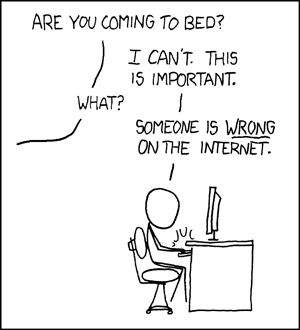
I think for blogs and websites, there is no middle ground. Either you go the old PZ Myers route* and allow pretty much all comments besides spam and harassment, or you go my route and pretty much eliminate comments**. You can make all the rules you want, but people want to have their say, and they always believe they themselves are being perfectly reasonable and polite; it's the other guy who's being an asshole... and sheesh! do they get pissed off when the moderator disagrees.

If you want a friendly, collegiate environment, I don't think there's anything to do but hang out with your friends or go to college.

*I have no idea if Myers still has this commenting policy. I stopped even reading his comments a long time ago.

**I still permit comments, but I am deliberately rude to people I don't like, so they will leave, and I ban them quickly if they persist. I get very few comments, especially compared to the early days of my blog, which suits me just fine.

Thursday, June 25, 2015

Barefoot no more

I have officially graduated from college, with a Bachelor's degree in Economics and Political Science. w00t.

Saturday, April 25, 2015

Useful and useless commentary

As much as I disagree with LK, he* always has reasons for why he holds the views that he has, and why he disagrees with people. See, e.g. the comments for Marx's project and Measuring socially necessary abstract labor time. We came to an impasse, but we argued our way there.

*Presumably; I don't know LK personally, and he or she has never explicitly indicated his or her gender.

In contrast, this comment is completely useless. The commenter, the-stone-guest, clearly disagrees with me. I don't mind people who disagree; I always think I'm right (if I thought I was wrong, I would change my mind), but I think I can change my views based on evidence and argument. If someone agrees that I can, then I really would like to hear the evidence and arguments why I'm wrong. The cited comment, however, does not do that; it basically consists of "Larry, you're wrong about this idea, you're wrong about that idea, and you don't even understand this other idea." The author does not even explain what the correct idea is. I asked for clarification, but none has yet been forthcoming. Perhaps the author will respond later.

To be honest, I don't understand why the-stone-guest even commented at all. I suppose it made him or her feel better, but it didn't advance my own understanding one iota.

Remember: I already know that people disagree with me (I try not to write about things that everyone already agrees about); knowing that you personally disagree with me does not help me at all. Hardly anyone even reads this blog at all, and no one but me reads the comments, so if you don't want to help me (and are not trying to intimidate* me), why bother commenting on my blog?

*It's very difficult to intimidate me, but an attempt at intimidation is at least a reason I can understand.

Wednesday, March 19, 2014

A perfect example

Persistent annoyance Occasional commenterMajor Nav pretty much illustrates the irritations I complain about in my recent post, On method:
From Major Nav:
You are fooling yourself to believe communism is a good thing or an achievable end.
To support your argument, you "study capitalism" to seek out examples of where you "believe" it is harmful while ignoring the harmful results of all previous attempts at communism. If anyone calls you on it, you just say "That was the old communism, I'm talking about neocommunism."
And you seek out authors and pick through their writings to select out of the context, an idea that is close to your concept and sprinkle them through your writings. Usually as a reference to the obscure article vs a direct quote. As if anyone else has read the article.

If all you have is a hammer, everything looks like a nail. Put down the hammer once in a while, take a step back and chose another viewpoint.

Let's break this down.

You are fooling yourself to believe communism is a good thing or an achievable end.

This is a "criticism" (actually just a complaint) about my conclusions, not my methodology.

To support your argument, you "study capitalism" . . .

This quotation is a blatant insult. I do not "study capitalism" with scare quotes; I actually do study capitalism, at an accredited university with a moderately prestigious economics department, I get excellent grades, and most every professor I have studied under or worked with — all committed capitalists — has offered to write me a letter of recommendation to any graduate school I wish to apply to. (And this ain't chopped liver: the reputation of an undergraduate program depends almost entirely on the performance of its students in graduate school; no professor will recommend a student he or she believes will fail.)

I'm not offended by the insult; the fact that ignorant tools like Major Nav have to depend on insult rather than reasoned argument shows the weakness, vacuity and dogmatism of their own position.

To support your argument, you "study capitalism" to seek out examples of where you "believe" it is harmful . . .

I have no idea why Major Nav puts "believe" in scare quotes; perhaps he is unfamiliar with the ordinary rules and meaning of English punctuation.

I don't need to study capitalism to discover examples of where it actually is harmful; I just need to read the newspaper. I study capitalism to discover why it is harmful, and where and why it is successful.

To support your argument, you "study capitalism" . . . while ignoring the harmful results of all previous attempts at communism. If anyone calls you on it, you just say "That was the old communism, I'm talking about neocommunism."

I understand that Major Nav is creating fictional dialog, but really: I have written (by a rough estimate) a half-million words on the blog, all searchable. Is it too much to ask that Major Nav actually quote me?

And I'm unsure of precisely what Major Nav is accusing me of here? Do I ignore the bad effects of communism, or do I recognize them, try to identify the causes, and change my ideology to account for that recognition? Is Major Nav trying to simultaneously accuse me of both dogmatism and rigidity on one hand and opportunism and excessive flexibility on the other?

And you seek out authors and pick through their writings to select out of the context, an idea that is close to your concept and sprinkle them through your writings. Usually as a reference to the obscure article vs a direct quote. As if anyone else has read the article.

What!? I engage with the scholarly literature, and cite and link to my sources? How rude! Can you get any more intellectually dishonest? I hang my head in shame.

If all you have is a hammer, everything looks like a nail. Put down the hammer once in a while, take a step back and chose another viewpoint.

This metaphor makes no sense. What does the "hammer" represent? A hammer is a tool, not a conclusion, and certainly not a viewpoint.

Let me reiterate:

I write about controversial topics. I already know that people disagree with me. I am absolutely uninterested that you personally disagree with me. I'm not particularly interested that people I already know and respect disagree with me or that people with impressive credentials disagree with me; if you're an anonymous, uncredentialed commenter, I care even less.

On the other hand, I'm very interested in specifically where and how you think I'm fooling myself. But remember, fooling myself is a methodological criticism. It is not only useless but also the epitome of dogmatic obtusity to assert, as does Major Nav, that I must be fooling myself just because I have come to a conclusion you disagree with.

Like any social person, I get irritated when people insult me. But being insulted has absolutely no effect on what I believe or understand; I have never changed my mind because someone insulted me, no matter how well I know the person or how highly I value their good opinion. If your intention is to gratuitously irritate me, go ahead and insult me. You'll get one (maybe two) shots, and then I will, like any rational person, simply refuse to engage with you.

Tuesday, March 18, 2014

On method

Recently, a couple of comments (here and here) prompt me to talk about method.

I take Feynman very seriously: "The first principle [of scientific integrity] is that you must not fool yourself--and you are the easiest person to fool. So you have to be very careful about that. After you've not fooled yourself, it's easy not to fool other scientists. You just have to be honest in a conventional way after that." I try, indeed I try very hard, to apply this principle in my criticism both of others and of myself.

Feynman's assertion raises two questions. First, what does it mean to fool oneself? Second, can we distinguish between fooling oneself and not fooling oneself, and if so, how?

Feynman makes it clear that fooling oneself is a matter of method. In his view, when someone distorts an argument to support a preconceived idea, he is fooling himself. Note that Feynman does not say that having or investigating a preconceived idea is by itself fooling oneself; fooling occurs when the investigator allows his preconceived idea to distort the argument. So what does it mean to "distort" an argument? Feynman uses subsequent investigations of Millikan's electron charge experiments as an example: the investigators distorted the data to get values closer to Millikan's answer, i.e. their preconceived idea of what the answer "should" be.

If fooling oneself is a matter of method, then it should be possible to tell the difference between fooling oneself and not fooling oneself by looking at the method. Science has a lot of interesting procedures to avoid fooling oneself. The most obvious is the double blind method: neither the subject nor the person collecting the data knows whether the person is being treated or is acting as a control. Since neither the subject nor the investigator knows what the answer "should" be (the preconceived answer is that there is a difference between the measurements of treated and untreated (control) subjects), they cannot bias the measurements. The double blind method seems like an effective technique for removing one kind of fooling oneself.

It is easier to fool oneself in philosophy and non-experimental argumentation, simply because there isn't an easy way like the double-blind technique to remove bias. But there are other ways. Does the author employ or avoid well-understood logical fallacies? (In my more cynical moods, I suspect that the primary project of academic philosophy is to teach students to write so turgidly as to prevent the detection of fallacies.) Does the author critically examine opposing viewpoints? Does she try to represent those opposing viewpoints fairly and honestly? These methods are not as tight and effective as double-blind testing, but they can, in my opinion, do a lot of work detecting and correcting fooling oneself.

Which brings me to the "criticism" of my own work cited above. First, I am always looking to see if and how other thinkers, especially thinkers with whom I disagree, fool themselves or avoid fooling themselves. Which means I am looking not at their conclusions, but at their methods. For example, when I examine Plantinga's Modal Argument, I look not at his conclusion that God exists, but at his method: I argue that he has made a methodological error, a logical fallacy. The question is not whether I am "motivated" to investigate his argument because I disagree with his conclusion, but rather whether my motivation has distorted my criticism, distorted my own argument.

A lot of the criticism of my work in the comments tends to come in three categories. First, people who just insult me. I have enough self esteem that insults from random people on the internet do not cause me the least distress. The only negative effect of this sort of criticism is irritation that I have to waste my time reading and possibly moderating a useless comment. Second, people who just assert their disagreement with my conclusion, which is again a pointless waste of my time (and if the commenter intends to affect my views in any way, a waste of his or her time). I really don't care that people disagree with me. It would be a waste of my time to write about what everyone agrees with; indeed, the more controversial a topic, the more interesting.

What I really do want to know is: am I fooling myself? If you do not believe I care whether or not I'm fooling myself, why even bother to comment? I honestly don't understand it. No one but me reads the comments, especially in older threads. Why even bother to register your dissent? If I want to fool myself, or I don't care about fooling myself and others, and registering dissent actually mattered, I would just delete the comments, which I can do without detection. (And you don't know I haven't, eh? But I leave them all in, unless they simply repeat an earlier point and I want to make clear that I am unwilling to waste any more of my time reading and moderating a commenter.)

I will give nontrivial attention only to criticism that addresses my method, i.e. how I construct my argument. Am I making a logical fallacy? Have I failed to address an important opposing viewpoint or argument? Do I make unexamined or unsupported assumptions? (Note too that this is a blog, not an academic journal; many posts here represent preliminary speculation, not fully-formed arguments.)

By the way, it's really important to cite and summarize opposing views and offer a basic analysis of how the opposing view affects my own argument. If you don't cite, I have no idea what you're talking about; even if I Google a vague referece, for example Edward Feser, I don't know whether what I find is what the commenter is referring to. If you don't summarize or analyze, I have to substitute my own judgment of the opposing viewpoint for my critic's, which just introduces bias. I have a limited amount of time, and if the work of someone such as Feser superficially appears to be worthless (and his work does superficially appear to be worthless), I'm not going to waste my time without some evidence that a deeper analysis is worthwhile.

I'm open to criticism; I really do believe that I can possibly be fooling myself, that I can possibly be ignorant of really good arguments that contradict my position (which is why, for example, as a communist I study capitalist economics). I don't even mind rudeness per se, but if you are rude, especially without direct provocation, your support should probably be stronger than otherwise. But if you're not interested in helping me figure out how I'm fooling myself, don't bother commenting. I take Heinlein to heart: "Never wrestle with a pig. You both get dirty and the pig likes it."

Thursday, January 24, 2013

Typical comments with typical answers

To pre-answer a few comments I often get:

Stupid comments:

You're wrong about X.

No, I'm not.

You're wrong about X, asshole.

No, I'm not. Fuck off.

I think you're wrong about X.
No, I'm not wrong, and I don't really care what you think; I care only about why you think it.

How dare you assert X?

Because I think it's true.  

How dare you fail to mention X!?

I don't know about it, I don't think it's true, or I don't think it's relevant in this context.

You failed to justify X.

Yes, I know. Sometimes I speculate, sometimes I summarize. This is a blog, not an academic journal. If you want to know why I think something, you need but ask.

You didn't justify X, so I don't have to justify to you my vehement assertion that you're wrong.

No, you don't have to justify anything at all to me. Indeed, you don't have to post here at all to not justify your opinion to me, so don't.

Mediocre comments:
You're right about X.

yay. I know. Do you have something to add?

Good comments:

Why do you think X?
You're wrong about X because of A, B, and C.
You failed to mention X, and it's important because of A, B, and C.
You're right about X, and it implies the surprising results of Y and Z.

Sunday, November 04, 2012

Summary and response

One of the disadvantages of not going to college as a young man is that I didn't learn then valuable techniques developed by academia that apparently are not well-propagated to the outside world. One problem that easily solvable by a stock academic technique is the problem of "fisking," creating a running, point-by-point critique of an essay or other written work. I remember fisking other people's posts back in the olden days when I posted a lot at the Internet Infidels Discussion Board. I felt that while it was thorough, fisking was a very ineffective technique. It somehow seems all to easy to miss the forest for the trees. For example, Andrew Louis recently commented on my post, Social constructions and Libertarianism. He's not fisking my post in the sense of trying to show that the post is completely, utterly, absolutely terrible, but the point-by-point form that Louis uses makes it unclear exactly what he is objecting to and why. There is an easy solution to this problem: the classic summary/analysis/response format taught in Freshman Composition at most colleges.

A standard summary/analysis/response (SAR) format consists of three sections, perhaps unsurprisingly, the summary, the analysis, and the response. Each section can be as short as a single paragraph. The summary neutrally summarizes the original work, without revealing the respondent's position. The analysis analyzes the effectiveness of the original work. The response gives the respondent's opinion or judgment of the original work. Essentially, the SAR format is: what did the original author say? How and how well does he or she say it? Is he or she right or wrong (or somewhere in between)? Structuring a critique in this way has some significant benefits.

The summary section begins with a reference to the original work and a statement of the original author's thesis. The thesis summarizes the author's main point in a short clause or sentence. The summary continues with an explanation of how the original author supports the thesis. (If the original author doesn't try to support the thesis, the work is probably not even worth criticizing analytically.) The summary usually ends with a paraphrase or summary of the original author's conclusion, tying the original thesis to the larger world.

After the summary, the analysis section begins with the critic's judgment of the effectiveness of the original work, which will usually include the major rhetorical styles (logos, logical argument; pathos, appeal to emotion; and ethos, credibility) of the original work. The analysis section will then support that judgment and description using evidence from the original work. The response section is not to agree or disagree with the author; it is to show how well or poorly the author employs the rhetorical techniques appropriate to the original work.

Finally, the response section informs the reader of the critic's judgment of the original work. Note that the judgment is often independent of the analysis. It is entirely possible that an author can construct a brilliant, clear, concise, and perspicacious argument that is nonetheless dead wrong. Again, the critic should support his judgment, but, unlike the summary and analysis sections, the judgment should include information outside the original work, including other cited sources, or the critics own experience and opinion.

This structure has some important advantages. The analysis examines the internal strengths and weaknesses of the original work, more-or-less unbiased by the critic's judgment, and the response section shows and supports the critic's actual judgment. But the summary section is the most important: it shows how the critic is reading the original work. The critic's reading may be completely different from the original author's intention. Such a difference would not mean the critic has read the original work incorrectly; the original author may have been unclear or obtuse, or the critic may be seeing valid implications beyond the original intention. In any case, any critical commentary is more intelligible and valuable if the reader of the criticism knows what precisely the critic is examining.

In my own case, most of the content of the blog is pretty much free-writing. I may have a thesis in mind when I begin—I might even state a thesis at its usual position at the end of the first paragraph—but I may swerve hard somewhere in the middle of the essay. I might not even have a thesis at all. (I do tend to ramble sometimes). When reading criticism of my work, the summary and analysis are especially valuable. I very well may not be saying what I want to say, but I can't know that until I learn how readers actually read it. I may well be making a terrible argument, but I need to know why it's a terrible argument, and what the critic thinks I'm arguing for. And finally, I might be dead wrong. I don't care too much that anyone thinks I'm dead wrong (I already know a lot of people disagree with me), but I'm keenly interested in why someone thinks I'm dead wrong. And in that case especially, I really want to know what a critic thinks I'm wrong about.

Summary. Analysis. Response. It's a pretty good structure. Learn it. Use it. Make it your friend.

For example, see Christianity and Suffering. I've slightly varied the format, but it still seems like a pretty good example of the SAR format.

Saturday, October 13, 2012

Freethought Blogs

Since as far as I can tell, all of the Freethought Blogs link only to other Freethought Blogs on their sidebars, I'm not going to link to any of them myself on my own sidebar.

Update Oct. 14: Ed Brayton links outside FtB, so he'll go on my sidebar.

Monday, May 07, 2012

Atheist spam

Someone is spamming my comments with links to the Rationally Speaking Podcast. Please stop. I do not accept spam from anyone. You may comment only if you want to contribute to a discussion.

If the person spamming my comments is not affiliated with the podcast, please let me know in here comments or by email. I'm not sure what I can actually do about it, but I'd like to know.

Wednesday, January 25, 2012

Thanks!

Thanks for the books, Eric! Wow! That means a lot to me.

They're going straight to the top of my reading list, and I'll post a review/reflection of each book when I finish reading it.

Saturday, January 21, 2012

Money for nothin'

For five years, I've been putting out some decent stuff — or so I think — here at The Barefoot Bum. I've never asked for anything before, but I have become an impoverished college student. So, if you like the content, feel free to buy me a book. Thanks!

Saturday, December 17, 2011

The Accidental Tutor

I've started another blog, The Accidental Tutor, to talk about my experiences as a Community College Writing Tutor and my thoughts on the theory and practice of instruction in English Composition.

Monday, December 06, 2010

One more week

One more week, and finals will be over. Until then, posting will be thin.

Sunday, October 24, 2010

Midterms

As some of you may have noticed, I'm going to college after lo! these many years. The last week or so I've been frantically preparing for midterms. (Now that I know the sorts of things I have to do, I'll be able to manage my time better in the future.) Two are done, one more to go on Monday, and then I should have a little more free time to write.

In the meantime, I'll still be posting various links to Cracked.com, just to piss people off. Mwahahahahaha!

Thursday, October 14, 2010

Help!

I need some help. I really enjoyed this conversation between Justice Breyer and Justice Scalia on how to judge, their philosophies on how to interpret statutes and the Constitution. Naturally, as I'm of a more liberal bent, as well as being on the flexible and pragmatic side, I find Justice Breyer's philosophy more compelling. But Justice Scalia has some interesting things to say as well.

In fact, I enjoyed this debate so much I want to write a paper on it for my political science class. To do so, however, I'd like to have a complete transcript of the conversation. So far, I've completed the first three substantive chapters — I've skipped the Introductions chapter, and completed transcribing Holmes or Hand, Conflicting Ethics and Constraining Personal Views — and I'm working on chapter 5, Purpose.

It would be of tremendous value to me if anyone would help me transcribe the program. Please note who is speaking, and throw in some time tags, so readers can easily find the actual conversation in the video.

I'll offer the completed transcription first to the Federalist Society for inclusion on the website; if they permit it, I'll publish it here for strictly noncommercial use. I'll also email the complete transcript to each person who helps.

If you'd like to help, reserve a chapter in the comments here, transcribe it and mail your transcription to me at lrhamelin (at) gmail (dot) com or post it here in the comments. If you'd like individual credit, please let me know in the email whether and how you'd like credit. I'll also generically credit my readers.

Update 11/1/10: Some progress!

Chapter Status

01: Introduction: skipped/available
02: Holmes or Hand: complete
03: Conflicting Ethics: complete
04: Constraining Personal Views: complete
05: Purpose: complete
06: A Living Constitution: in progress: Larry
07: Conflicting Text of the Constitution
08: History
09: Active Liberty
10: School Voucher Case
11: Q
12: Q1 - Intent of Founders
13: Q2 - Pragmatism: in progress
14: Q3 - Activist Judges: complete
15: Q4 - Supreme Court Criticism: complete
16: Q5 - More Unanimous Decisions: complete
17: Q6 - Boldness: complete
18: Q7 - Morrison v. Olsen: complete
19: Q8 - A New Justice Makes a New Court: complete

Sunday, September 05, 2010

Things I don't care about

I don't care at all that people disagree with me. I already know you disagree with me. I don't really care, frankly, that people even agree with me: There's no statement so egregiously wrong that someone won't enthusiastically agree. (I am interested if I actually changed your mind on some point, or at least clarified your thinking.)

If Paul Krugman himself were to come here and say only, "Larry, I have a Ph.D in economics, and I say you just don't know what the fuck you're talking about," I wouldn't be interested. (Of course, the good doctor is not a jackass; if he cared enough to comment, he'd care enough to post a devastating (and probably correct) argument showing precisely why I didn't know what the fuck I was talking about, and I would change my mind.)

I don't really care about your personal experiences. I don't care that you live in a communist country and you therefore know communism sucks. I don't care that you used to be an atheist and you now know that God exists. I don't know you, I don't want to know you, and I can't place your personal experiences in enough context to draw any conclusions. Maybe you're just the sort of greedy asshole that's just not going to thrive in a communist country. Maybe you were an atheist for all the wrong reasons, and now you're a theist for all the same wrong reasons. Maybe you just hate borscht. Or maybe not: I don't know and I'm not going to do the work to find out.

I don't care about your criticism — however elaborate — of what you think I believe, or what you think I ought to believe. Seriously: a huge chunk of the criticism I get for calling myself an atheist and a communist (and don't even get me started on philosophy) addresses beliefs and opinions I've never expressed and some I've explicitly denied. I've written a couple hundred thousand words on this blog: It's trivially easy to find something I've actually written to criticize.

Thursday, July 15, 2010

Comments

[Last updated 8 Sep. 2012]

I've decided to restore comments.

As before, spam, pr0n, threats, commercial advertising, completely off-topic comments, batshit insanity (that means you, David Mabus) and outright lies about matters of fact (yes, you, Rob Singleton) will not be published. Otherwise, I'll publish most everything else. I don't care about profanity. Feel free to call me a fucktard. You don't need a "hard" identity (Google account, email address, etc.); you may use a handle. Word verification is on to keep spambots from making too much extra work for me.

I will rarely respond directly to comments. I will usually respond only to provide additional evidence or in rare cases clarification of points I myself consider unclear. I might create another post generally based on questions or criticism in comments, but don't hold your breath. Usually I've said what I have to say; 90% of criticism is from those who apparently cannot read and understand simple declarative sentences in the English language; it's usually a waste of time repeating my arguments. If you want a specific response, or you want to debate or argue with me in any sense, you can email me. I won't promise anything, but you at least have a shot.

When commenting, you must address me, not other commenters, in a similar fashion as addressing the Chair in parliamentary procedure. If you want to address another commenter directly, do it by email, their blog or your own, or find a message board. In general, I'm not interested in hosting debates between commenters. If I feel a debate is brewing, I may close comments for the post.

I cannot edit comments, and would not if I could. I myself cannot (and would not if I could) keep any records regarding the origin of comments or the locations, IP address and any other identifying information about commenters. I cannot speak for Google.

Occasionally I moderate comments. I do so only when I am being overwhelmed with spam or when a hostile or abusive commenter is harassing me. If moderation is turned on, be patient; I will approve most comments as soon as I can.

Pick a handle or moniker for your comment. With few exceptions, I will not respond or reply to purely anonymous comments. I may delete anonymous comments. If I have comment moderation turned on, I am far more likely to reject a comment if it is anonymous.

I keep a copy of all comments; if you want the text of a comment I have rejected or deleted, feel free to email me and I'll send it to you.

Finally, I retain the unconditional privilege of publishing, rejecting, or deleting comments at my arbitrary discretion.

Monday, May 10, 2010

Social networking

I am not an active member of FaceBook, MySpace, LinkedIn or any other social networking site. I do not play any MMORPGs. I do not have an active account on any message board, discussion board or any other conversational forum. I do not use Skype, AIM, ICQ or any other chat program. There may be some remnants of past activity in these areas, but I no longer check them.

I have this blog, an email account (that sufficiently clever readers of this blog can find), and a phone.

If you try to friend me, or buddy me, or whatever it is that's done at these sorts of places, I'm not ignoring you: I'm simply unable to respond. Either I don't have an account (as best I can tell, FaceBook does not require an invitee to have an account), or I've long forgotten the password and I'm disinclined to retrieve it.

I make no judgments: if you use these sorts of media, good for you. They don't work for me, however, so I don't use them.

Thursday, April 29, 2010

Blogroll and comments

I've trimmed my blogroll. I'm keeping only:
  • Blogs I read regularly
  • Blogs that I don't read, but I think are important
  • Blogs that link to me, unless I really dislike them.
I may have made a mistake. If you're linking to me and I'm not linking to you, I may not know about the link, or I may have deleted you in error (the mouse does slip from time to time). If you care, send me an email.

AFAIK, most site ranking algorithms ignore blogrolls. I almost never click blogs from other people's blogrolls. I conclude their utility is limited.

I've also turned off comments. Some blog authors like them and find them valuable, but I don't. As far as I'm concerned, there are three useful functions for blog comments: To build a community (e.g. Pharyngula), to correct errors of fact, and to conduct reasonable debate about complicated issues. I'm not interested in building a community, and I'm careful enough about the facts; if you want me to correct an error of fact, you're welcome to email me.

I'm interested in reasonable debate, but 95% of the people who disagree with me are either flat-out liars (e.g. Christians) or idiots (e.g. anarchists). There have been a few good exceptions, but not enough to be worth the trouble of the jackasses whining that I'm some sort of Maoist tyrant because I won't publish their stupid, argument-free dogma in the comments on my blog. Regardless of whether I'm correct or mistaken, it seems like I'm so far out of any ideological box that my opinions put seemingly reasonable people into a state of apoplectic rage or embittered betrayal. I just don't care that you don't like me any more because of what I said. I learned long ago that most people don't like me no matter what I say or do; if that's the result of a flaw in my character or intellect, it's one I'm powerless to correct.

If you don't like what I have to say, write about it on your own blog. If you do like what I have to say, write about it on your own blog. I don't pay much attention to links, so if you want me to respond, you'll have to email me.

You are free to republish without changes anything original I publish here, with attribution and a link. (For content I republish, you'll have to follow the licensing of the original author.) Of course fair use permits excerpts for several purposes, including critical commentary.

If you have questions or want clarification about something I've written, email me. Unless you tell me otherwise, I'll refer to you anonymously and paraphrase your comments. If you want to argue — with evidence and reasoning — that I'm wrong, email me. I'll anonymize and paraphrase by default, but if you give me explicit, specific permission I'll consider publishing your unedited argument as a post, with whatever attribution you specify.

If you want to tell me what a big jerk I am, you can email me. If it makes you feel better to get it off your chest, good for you. Remember, though, I assume unless proven otherwise that everyone thinks I'm a jackass, so don't expect me to be crestfallen that you personally think I'm a jackass.