Saturday, July 08, 2017

Sturgeon's law

Theodore Sturgeon famously noted that "ninety percent of everything is crap."

I repeat Sturgeon's Revelation, which was wrung out of me after twenty years of wearying defense of science fiction against attacks of people who used the worst examples of the field for ammunition, and whose conclusion was that ninety percent of SF is crud. Using the same standards that categorize 90% of science fiction as trash, crud, or crap, it can be argued that 90% of film, literature, consumer goods, etc. is crap. In other words, the claim (or fact) that 90% of science fiction is crap is ultimately uninformative, because science fiction conforms to the same trends of quality as all other artforms. [emphasis added]

The Wikipedia article observes that philosopher Daniel Dennett has reintroduced the observation as an important tool for critical thinking.

Hence I am usually unimpressed by people offering anecdotes about any group doing stupid stuff. Stupidity is interesting, and I appreciate a good laugh at some doofus doing or saying something stupid, but such anecdotes are, as Sturgeon notes, "ultimately uninformative." Thus too with free speech issues on college campuses.

I would add, however, to Sturgeon's law that 90 percent is a lower bound; some topics reach 100 percent crap.

It is not enough to to draw conclusions about a broad topic to dredge up any number of examples of egregiously stupid shit. Sturgeon's law guarantees that there will be no shortage of such examples. We should really try to analyze the best 10 percent.

Furthermore, I think there we can usefully analyze even the stupid stuff. Individual analysis always useful: if so-and-so (<cough> Sam Harris) says something stupid, it's an intellectual virtue to point out that that specific said that specific stupid, and to show how it's stupid. Additionally, not all crap is the same. The ordinary kind of crap is just lazy: the author has simply not thought their position through. In contrast, in some topics, the crap is egregiously lying, completely contrary to actual facts. Generally, when I see a huge percentage of flat-out lies in the crap of some topic, I feel like I can draw conclusions about the topic.

We can also look at the general moral stance of the crap. If most of the crap seems generally morally reprehensible, I'm going to draw the conclusion that even the good stuff is contributing to the moral failure seen in the crap.

While I usually like Fredrik deBoer, his recent essay, "There’s no pro-campus censorship theory for me to debate", is a little frustrating. deBoer offers anecdotes, unsourced, of people failing to make good arguments on consistent principles for campus actions that seem to (maybe) impinge on free speech. I assume they're accurate (deBoer seems scrupulously honest), but veracity isn't the important thing here; I want to know whether deBoer is just plumbing the depths of the 90 percent of crap. And the anecdotes that deBoer offers just show ordinary laziness that is not facially reprehensible. So, while I take his point that academics should construct good arguments for whom they do and do not invite to campus, that he has given us examples of bad arguments doesn't tell us anything new.

I think a good principled argument is actually relatively easy to construct. deBoer complains, "Why do these controversies so often fall along predictable partisan lines?" Well, why shouldn't they? If the struggle is actually partisan, then of course these

I'm neither a liberal nor a conservative, but liberals consider conservatives to be not mistaken but actually evil; likewise, conservatives consider liberals to be evil.* I think both positions are, in a sense, "legitimate," in that they might be wrong, but they're not incoherent. If you think some group is actually evil, you have to fight them, and it's impossible to insist on absolute moral purity for everyone opposing them. Hence the liberal students are fighting against conservatism, and so what that people like the Clinton's are not morally pure; at least they're on the right side... or at least not obviously on the wrong side. In a struggle you fight, and as long as the person next to you is aiming in the correct direction, you don't need to ask too many questions. The campus "free speech" issues deBoer points out might not be not a debate on universal values, but rather what it appears to be: a partisan struggle. I think that's a position coherent and principled enough to be worth debating. but an actual partisan fight.

*My personal opinion is that conservatives are indeed completely evil (or completely deluded), and liberals slightly less evil; they mean well, but they're mostly... not exactly stupid, but they're missing too many important points.

Supposing that it is a partisan fight, I don't think deBoer's substantive criticism holds water. deBoer writes,
[Pro-censorship leftist]: What, you want to give “mainstream conservatives” a place to speak on campus? Any conservative contributes to racism, war, and poverty!

Me: Considering we’ve been arguing for decades against the perception that campus is a left-wing indoctrination center, and that the GOP has used that perception to massively defund public universities, this seems like a suicidal stance.

First, of course, I think his labeling of advocates he disagrees with as "pro-censorship" — an obviously value-laden term — poisons the well; he employs the term to label the position, not the argument. I think it might be possible to argue the position that actions such as protesting the invitation of speakers such as Milo Yiannopoulos, Richard Spencer, or Condoleeza Rice constitutes "censorship," but it's not so obvious that deBoer can simply assume it.

More importantly, no matter what campus liberals do, as long as educated people and people in academia struggle in any way against conservatives, the GOP will itself create the perception that "campus is a left-wing indoctrination center." This whole line started, as best I can tell, when students started protesting the Vietnam war. Furthermore, the conservative war against academia has little to do with students protesting conservatives; the conservatives are struggling against the professional-managerial class, and academia is the foundation of their legitimacy. Even if students passively accept whatever speakers their administrators deem acceptable, conservatives will not rest until academia is either destroyed or brought completely under the control of the "free market."

deBoer continues, "But anyway — you think the average Democrat doesn’t contribute to racism, war, and poverty?" I completely understand his frustration here, and I feel much the same. Still, commies like deBoer and I are completely marginal in the actual struggle against conservatism. The Bolsheviks welcomed the Kadets in the struggle against the Tsar, so too could we communists at least not complain too loudly and too generally at the struggles of those who do not share our proletarian purity.

I'm not on the side of the liberals or the professional-managerial class. However, the only universal value I see at stake here is that even a completely socialist government should not imprison Yiannopoulos, Spencer, or Rice just for their views. Other than that, fuck them. I don't care who does it, if the pressure of public opinion can stuff these assholes under the rocks they crawled out of, I'm not going to waste my breath defending them.

Tuesday, July 04, 2017

What is free speech?

Free speech is impossible.

To be genuinely free, free speech must be free of all coercion, not just of coercion exercised directly by the state. If some non-state institution uses coercion, then either the state itself legitimizes the coercion, it which case the coercion is still state coercion, or the state does not have a monopoly on the exercise of coercion, and is not a state at all. Thus, if I say, "The sky is blue," and vigilantes beat me up without fear of state reprisal, then the state has coercively restricted my speech, so I do not have free speech.

But! Speech may itself be coercive. If I walk up to a bank teller and say, "Give me all your money, or I'll shoot you," I am coercing the teller (and the bank, its depositors, and its owners). There is a contradiction: if the state regulates this coercion-by-speech, we lack free speech; if it cannot, it is not a state at all. Worse yet, if I say, "Do not say that the sky is blue, or I'll shoot you," someone's free speech will be violated: either my own — I am prohibited for speaking thus — or the person I'm threatening, who fears to say that the sky is blue.

Indeed, we have broadened the definition of "speech" to communicative acts: if burning a flag is a speech act, then pointing a loaded pistol at someone — so long as I do not pull the trigger — is objectively a speech act. One might argue (sensibly) that threats are substantively different than other speech acts, but to restrict any speech for any reason, however sensible and reasonable, is still infringing on someone's freedom of speech.

The point of the above exercise is to emphasize that we are arguing not about whether or not we should have "free speech" but about the limits and boundaries of permissible and impermissible speech, what institutions actually set those limits, and how they go about setting them.

The question then becomes on what basis are we to determine the limits? As I work through the sources, I'm going to try and determine both where each source advocates the limits should be, and, more importantly, why those limits should be as they advocate.

Sunday, July 02, 2017

Free speech, political correctness, and higher education - first bibliography

Fine. I'm going to bite the bullet and do a scholarly investigation of the topic of free speech, political correctness, and higher education. This post will contain a first pass at a non-annotated bibliography. If you have any suggestions for additional sources, please let me know in comments.

My working research question is: are the values of political correctness and free speech in substantial conflict in the context of higher (postsecondary) education? I will define both terms, and investigate where and to what degree they do in fact conflict. I will judge the merits of both sides, and come to a conclusion about the degree we should support each value.

Scholarly sources
Wilson, John K. (1995) The myth of political correctness: The conservative attack on higher education. Durham and London: Duke University Press.
Rychlak, Ronald J. (1992-1992). Civil rights, Confederate flags, and political correctness: Free speech and race Relations on Campus. 66 Tul. L. Rev. 1411
Cheney, Lynne V. (September 1992). Telling the Truth. A Report on the State of the Humanities in Higher Education. National Endowment for the Humanities.
Scott, Peter. (2016). "Free speech" and "political correctness." European Journal of Higher Education 6.4: 417-420. doi:10.1080/21568235.2016.1227666.
Pujol, Jordi. (2016). The United States safe space campus controversy and the paradox of freedom of speech. Church, Communication and Culture 1.1: 240-254. doi:10.1080/23753234.2016.1234124.
Kitrosser, Heidi. (2016-2017). Free Speech, Higher Education, and the PC Narrative. 101 Minn. L. Rev. 1987
Robbins, Susan P. (January 19 2016). From the Editor—Sticks and stones: Trigger warnings, microaggressions, and political correctness. [editorial] Journal of Social Work Education 52.1: 1-5. doi:10.1080/10437797.2016.1116850.

Non-scholarly sources
Google "free speech political correctness and higher education"

Roth, Michael S. (August 31, 2016). Free speech, political correctness and higher education. Huffington Post.
Lukianoff, Greg, and Jonathan Haidt. (September 2015). The coddling of the American mind. The Atlantic.
Schapiro, Morton. (January 15, 2016). I’m Northwestern’s president. Here’s why safe spaces for students are important. The Washington Post
Cobb, Jelani. (November 10, 2015). Race and the Free-Speech Diversion. The New Yorker.
Strauss, Valerie, (November 20, 2015). Sick of hearing about pampered students with coddled minds? This university president is. The Washington Post
Zimmer, Robert J. (August 26, 2016). Free speech is the basis of a true education. The Wall Street Journal.
Stone, Geoffrey R. (August 26, 2016). Free expression in peril. The Chronicle of Higher Education.
Friedersdorf, Conor. (June 30, 2016). Should any ideas Be 'off the table' in campus debates? The Atlantic.
Roth, Michael. (September 19, 2015). Black lives matter and so does free speech. Wesleyan University.
Gersen, Jeannie Suk. (December 15, 2014). The trouble with teaching rape law. The New Yorker.
Kipnis, Laura (February 27, 2015). Sexual paranoia strikes academe. The Chronicle of Higher Education.
Cooke, Rachel. (April 2, 2017). Sexual paranoia on campus – and the professor at the eye of the storm. The Guardian.
Schlosser, Edward [pseudonym]. (June 3, 2015). I'm a liberal professor, and my liberal students terrify me. Vox.
McCormick, Jason . (December 1, 2016). I’m a liberal professor and my conservative students terrify me. The Coffeelicious.
Berlatsky, Noah. (June 11, 2015). Professors do live in fear—but not of liberal students. The New Republic.
Griswold, Alex. (June 3, 2015). Liberal professor vilified As racist for accurately quoting activist. The Daily Caller.
Flaherty, Colleen. (January 30, 2015). Going after the donors. Inside Higher Ed.
Steinhauer, Jillian. (June 20, 2014). South Carolina legislature penalizes colleges for teaching gay-themed books. Hyperallergic.
Kendall, Nancy. (June 9, 2015). Scott Walker is undermining academic freedom at the University of Wisconsin. New Republic
Hentoff, Nat. (Fall 1991). "Speech Codes" on the campus and problems of free speech. Dissent 38: 546-9.
Chait, Jonathan. (January 27, 2015). Not a very P.C. thing to say. New York Magazine, Daily Intelligencer.
Goldberg, Jonah. (February 16, 2015). The University of Michigan's tolerance problem. Los Angeles Times.
Mahmood, Omar. (November 19,2014). Do the left thing. Michigan Review.
Fields, Suzanne. (May 20, 2015). The slow death of free speech. The Washington Post.
Barone, Michael. (Jun 22, 2013). Why does the left want to suppress free speech?
Quintana, Chris, and Brock Read. (June 22, 2017). The Chronicle of Higher Education.
deBoer, Freddie. (June 26, 2017). There’s no pro-campus censorship theory for me to debate. Medium.

I have not yet carefully evaluated any of the sources. Some sources may be dodgy; hopefully, I'll be able to replace them later with more reliable sources.

Damn. I am barely scratching the surface. More later.

Tuesday, June 27, 2017

Philosophy solved!

Philosophy solved!

Note that on the one hand, I agree substantially with Atheist Freshman Philosophy Student: the world really is matter (but quantum mechanics shows us that matter is really quite complicated and strange), statistics and good experimental design gets us as close to "proving" causality as we want, and morality really is relative (to our subjective feelings), and a robust version of utilitarianism really is the best we can do as a socially constructed morality. And there are indeed no gods.

If the goal of philosophy really is to find out the true nature of physical reality and the best socially constructed morality, then yes, the problems of philosophy have been "solved". In much the same sense, the problem of the planets moving around all higgledy-piggledy was "solved" by Newton. Yay!

(I disagree with the character of Bertrand Russell: I don't think AFPS says anything fundamentally contradictory; I think any apparent contradictions come only from an uncharitable reading of ambiguous language.)

I think there are no small few philosophers who do see the above as the goal of philosophy, whom the author brilliantly satirizes in the final two paragraphs.

But I think I might agree with the author, in the sense that I don't think the goal of philosophy really is to find out the true nature of physical reality. All I can give you is my semi-informed opinion, but that opinion is that philosophy is a literary genre, and is a part of the search for truth in precisely the same sense that literature in general is a part of the search for truth. And that ain't chopped liver.

Take any great work of fiction, from Gilgamesh or the Iliad to The Sellout. Clearly (or so we assume) the actual events in a work of fiction are not literally true. And great works of fiction seem to interact with the truth-seeking parts of our minds in ways that lesser works of fiction do not. Thus too for philosophy. Plato is still worth reading even if his Theory of Forms is not literally true, and Plato is still worth reading not because his work is entertaining (which it is, notwithstanding his literary flaws, Plato is a rather good writer, especially in The Republic), but because he seems to interact with the truth-seeking parts of our minds.

I think it's pointless to argue about the underlying value philosophy. You either like philosophy or you don't. I don't care about the aesthetic or emotional problems that medieval French poetry addresses, I don't care about the poets' solutions to those problems, so I don't even read, much less study, medieval French poetry. It's useless to me personally, but if you like it, knock yourself out. But if you tell me I am an incomplete or unworthy human being just because I don't study medieval French poetry, make a damn good case or go fuck yourself.

Thus too with philosophy. As a literary endeavor, philosophy doesn't need to justify itself scientifically, any more than Plato needs to establish that Phaedrus was an actually existing person, and that his conversation with Socrates actually happened for the Dialog to be valuable. And that Richard Dawkins or Neil deGrasse Tyson does not find philosophy valuable should have no more import to philosophers than my indifference should have to scholars of medieval French poetry.

Saturday, June 24, 2017

The economics of queer representation in video games

Siggy at A Trivial Knot wonders whether capitalism is to blame for the lack of "good queer video games." He doesn't seem to think that capitalism is the cause; instead, he suggests a utilitarian cause: the cost of developing good queer video games exceeds the social benefit, so it doesn't make sense — from a utilitarian perspective — to spend the resources to develop queer video games or increase queer representation.

I don't play video games, and I'm not queer in any ordinary sense, so I don't know what a queer video game is nor what queer representation entails; the comments in Siggy's post suggest that these questions are not settled among people who know more than the exactly zero that I know.

I do know a few things about economics, so I want to talk about the economics. I will use the generic term queer video games for whatever it is that queer people would like to see in video games, and I assume that people who are interested in queer video games find the supply insufficient. Please note the heavy use of conditionals and the subjunctive.

I am also discussing the issue of theoretical capitalism. The actual world has many features that are absolutely contradictory to capitalist theory. For example, capitalist theory predicts that video games should market equally to men and women; video games target mostly men because sexism, and possibly do not produce queer video games because of a similar bigotry. We could dig deeper into the marginalization of women, people of color, queer people, etc. as a mechanism the capitalist ruling class uses to maintain its social and political domination, but I think these are features of ruling classes in general or exist in specifically capitalist societies for historical rather than theoretical reasons.

If Siggy's conjecture is correct, and the positive utility — by some good measure — of queer video games is outweighed by the disutility of opportunity costs, then I don't see utilitarianism as a "problem"; I think it is exploitative and morally wrong for any person or group to demand more utility from society than they return. If so, then queer people would no more be entitled to queer video games than I would be entitled to a trip to the Moon. We wouldn't need to look at economics at all.

However, utility is a very difficult concept to define and measure, which is the most legitimate criticism of utilitarianism. (I don't think it's a fatal criticism; philosophers have had for a couple of millennia considerable difficulty creating and supporting ethical definitions and measures in general. I think the most legitimate criticism of alternative ethical philosophies are that they oversimplify ethics and introduce assumptions at best dubious (e.g. Kant) and at worst outrageously class- or self-serving (e.g. Aristotle).) Thus I think it is more fruitful to look at how utility is defined and measured in a capitalist democratic republic, and examine under what alternative social constructions the production of queer video games might have positive net utility.

In examining Siggy starts with the problem of high capital costs coupled with low marginal supply costs. He finds that at least with regard to queer video games, this problem is not one of specifically capitalism. He is, I think, correct on this count. Absent substantial externalities, even a Labor Theory of Value Marxists such as myself would say that if producing any video game costs a million socially necessary abstract labor hours, then if consumers are not willing to collectively contribute at least a million hours in return, then the effort is at best wasteful and at worst exploitative.

As a side note, the problem of high capital costs — indeed of capital costs in general — and low marginal supply costs seems to me an enormous problem in economics that has been almost completely ignored in my undergraduate and Master's level education.* The definition of capital we use in my coursework — rent paid to households who own the physical means of production and lend those machines to businesses — is almost but not quite completely unrepresentative of how businesses actually operate.

*I've only taken courses in economics at two schools, but they're both accredited, so I assume my education is at least somewhat representative.

I don't want to delve too deeply into the capital/marginal cost paradox. See the Cambridge Capital Controversy, as best I can tell still unresolved, for some background. In Railroading Economics, Michael Perelman examines the first capital crisis of high capital costs vs. low marginal supply costs caused by the development of railroads in the United States in the mid 19th century, and mirrored substantially in the airline industry today.

Anyway... I don't think the lack of queer video games reflects anything about how capitalism in general solves the problem of capitalizing specifically high capital/low marginal cost production. But that doesn't mean that capitalism is not the cause of the lack of queer video games.

A more salient aspect of capitalism is how capitalism generally measures the utility of goods and services (or, more precisely, the utility of the socially necessary abstract labor time embodied in goods and services). Capitalism measures utility via the mechanism of profitable exchange value under enforced inequality of wealth and income. The utility of a good is its monetary profitability. A wasteful good (negative net utility) will probably be unprofitable, but an unprofitable good is not necessarily or even probably wasteful.

Of course one reason is simply social. If it's just an asshole move to exclude queer video games, and capitalism does not do all that much to restrain assholes, then I guess capitalism might be at least an indirect cause.

One way that queer video games could have positive net utility but still be unprofitable is because the people who want these games have disproportionally less money to pay for them. If we measured utility less unequally, we might have more queer video games. If so, we could say that capitalism was indeed the cause of the lack of queer video games.

Another mechanism is if queer video games have substantial positive externalities, i.e. they offer substantial positive utility to people who don't actually buy them. For example, queer video games might contribute to greater acceptance and less social oppression of queer people, which would have positive utility not only for queer people who do not play video games but also for people such as myself, who would see greater acceptance as a definite social positive. Again, because capitalism is notoriously bad at pricing externalities, we could then locate capitalism as the cause.

Yet another mechanism is lack of differentiability. If no one is willing to pay money for a queer video game, i.e. buy a game they wouldn't otherwise buy just because of its queerness, then there's no incentive to spend even a little extra to include queerness. Alternatively, companies might reason that if one person does it, everyone will do it, and no one will have a marginal benefit. If they believe this "arms race" will equalize before any improved profit can be generated, especially if they think there might be a short-term backlash which would depress profitability in the short run. Again because under capitalism firms must concentrate on differentiation that is hard to replicate, a different way of allocating capital and conducting business might give a different result.

Tuesday, June 20, 2017

Scientism and philosophy

As I wrote a little earlier, the charge in commentary to this Existential Comics cartoon (the cartoon itself is fucking hilarious) that New Atheists (who have, as far as I can tell, been defunct as a movement for nearly a decade) are leading the charge against philosophy is without merit. The assertion that scientism "is closely tied to movements like the so-called 'New Atheists'," is so patently false that I would be very much surprised to find that the author has read a single book published by or often referenced by New Atheists, much less Googled the social discussion that comprised the meat of New Atheism as a political movement to erode religion's social privilege. The charge of New Atheists' "scientism" was a canard foisted by religious fundamentalists, and I spent the better part of my decade as a New Atheist activist refuting the charge. But as the saying goes, a lie travels halfway around the world while the truth is still putting on its pants, and the author finds it easier believe the lie than to dig for the truth. But there are deeper flaws in the author's argument that have nothing to with New Atheism.

The author deftly couples a straw man with the fallacy of the excluded middle. The straw man is "scientism", and the author seems to know it's a straw man:
Rhetorically, [proponents of scientism] tend to say that non-empirical ideas have no way to guarantee they are true, so are pointless to talk about. This is a rather ridiculous point to make, since their entire movement is based around spreading a certain set of non-empirical, philosophical norms, which they apparently don't feel it necessary to open up to criticism. [emphasis added]
Of course it's a ridiculous point to make. If you're going to attribute a ridiculous point to someone, I think it's at least intellectually negligent if not actually dishonest to not actually, you know, support the attribution with sources and quotations. To be honest, I haven't seen anyone propose this point of view since the logical positivists themselves dismissed the idea as obviously untenable in the 1920s.

(And in what sense does anyone refuse to open up anything to criticism? What does that even mean? As best I can tell, if you publish something, then you're opening it up to criticism right there. The author him- or herself is, you know, actually criticizing... well... something. I'm not sure what the author is criticizing, other than Christopher Hitchens', Sam Harris's and Richard Dawkins' outrageous sexism, a criticism roundly shared by no small few New Atheists, myself included. Ironically, the author states, "Please send your hatemail to idontgiveashit@existentialcomics.com." I suppose this is the epitome of opening up to criticism.)

The author seems to propose that "scientism" is the only alternative to somehow embracing philosophy, which is nonsense. First, I don't even know what either the author or the critics he cites actually means by philosophy. Does the author mean some Platonic Ideal of philosophy? What academic philosophers actually do? The philosophical canon? Regardless, there are a lot of ways to criticize philosophy in any sense without committing to scientism: one could believe there is more than just empirical science, but whatever that is, philosophy isn't it, or philosophy is not an effective way of investigating it.

But the most serious charge the author lays is that opponents of philosophy use their opposition to preserve existing power structures: "The real goal is often just to draw a border around what we should or shouldn't question, because they don't want any of the fundamental aspects of society to change." Certainly the real goal of all people everywhere who have privilege is to exempt their privilege from criticism. And certainly atheism is no cure for the protection of privilege, as Hitchens, Harris, and Dawkins obviously show.

But it is odd to single out a movement — not just a few clueless, albeit famous, jerks — that had the intention of taking religion, something substantial, perhaps even fundamental, inside the border around what we shouldn't question and spending a decade trying to move it outside that border as people who "don't want any of the fundamental aspects of society to change. [emphasis added]" And it seems odd to single out a movement that included professional philosophers, not only Daniel Dennett but also (just off the top of my head) Stephen Law and Nigel Warburton, as being somehow fundamentally anti-philosophical.

I like philosophy. I haven't read as much as the author, but I have read more than my fair share, and I've taken a few philosophy classes in college. I'm obviously not an expert, but neither am I entire ignorant, and I'm certainly not at all hostile to philosophy. But, with perhaps the exception of Marx, philosophy is while not the last thing that defenders of the status quo need to worry about, it's pretty far down the page. I decided not to study philosophy in college precisely because while I find it enjoyable, I did not see any way to contribute anything at all I found valuable. I did not see any room in academic philosophy, not even the tiny room I've carved out for myself as a college economics instructor, to affect society, to fight oppression, or even discover the truth, whatever that may be.

I'm not saying that philosophers have any more obligation to fight oppression — or even discover the truth — than anyone else. I don't think classical music will fight oppression, but I have nothing against professional classical musicians. And I don't think I'm absolutely correct when I fail to see anything in philosophy that socially useful; I say only that after at least a non-trivial search, as a person of ordinary intelligence, I didn't find it. So when I see someone saying that the only reason, or at least the primary reason, to criticize philosophy is to adopt an obviously ridiculous position to preserve the status quo, I ain't buyin' it.

A final (?) note on New Atheism

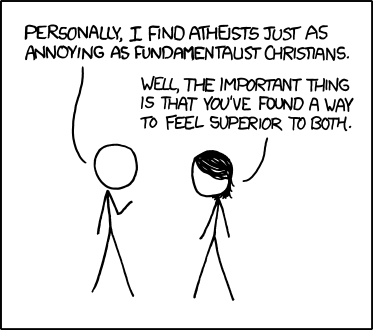
Atheists
Before I actually went to college to study economics, political science, and mathematics, I was strongly considering studying philosophy. Repeated contact with academic philosophers cured me of that notion, not because I thought that philosophy itself was useless but because I found academic philosophers to be uptight and annoying. There are no small few problems in economics and political science, but I would rather have lunch with an economist than a philosopher. And there's more math in economics; I like math.

I really like Existential Comics because the author is most decidedly not uptight and annoying. The author makes philosophy entertaining and fun, and he or she is a pretty good Marxist. Seriously: go read the comic from the beginning.

However, the commentary on today's comic is kind of annoying. It reduces New Atheism, a movement I was a part of for a decade, to a caricature. Like any good caricature, it has an element of truth, but only an element, and misses a lot of the complexity of the movement and the positive gains we made.

The New Atheist movement was a phenomenon of the late 1990s and 2000s; by the early 2010s it was defunct as a movement. I don't know anyone today who calls him- or herself a "New Atheist"; I don't remember PZ Myers having used the term for many years now.

The author of Existential Comics justly calls out Richard Dawkins, Sam Harris, and Christopher Hitchens* for their anti-feminist bullshit. But as thousands of New Atheists have been complaining since 30 seconds after The End of Faith was published, Dawkins, Harris, and Hitchens were not in any way, shape or form leaders of the New Atheist movement. The New Atheism movement by its very nature did not and could not have leaders. Sure we liked The End of Faith, The God Delusion, God is Not Great, and Breaking the Spell, but we also criticized the errors and weaknesses of these books. They were at best starting points, not ideological foundations.

*The author also mentions Neil deGrasse Tyson, but as far as I know, Tyson has never identified as a New Atheist. Curiously, the author does not name another noted New Atheist author, professional philosopher Daniel Dennett.

New Atheism was a movement primarily dedicated to demolishing the social, economic, and political privilege of religion. New Atheism was about criticizing religion as a popular phenomenon, not confined to dusty tomes with a readership in the high tens. The books mentioned above were important not because they codified any ideology (in contrast, say, to Marx, who, for better or worse, actually codified and established a lot of communist ideology). There is nothing in any of those books (except perhaps some cognitive science in Breaking the Spell) that would surprise any denizen of the Internet Infidels Discussion Board (atheist or religious). They were important because they were popular: they challenged the taboo against criticizing religion in public, and they got away with it.

But the whole point of New Atheism was that it did not depend on noted authors. If the critique against religion had been confined to The God Delusion, there would not have been such a thing as New Atheism. New Atheists such as myself were certainly inspired by these books, but New Atheism consisted of thousands of bloggers, discussion board participants, and other contributors to internet media who criticized religion in public. The whole point of New Atheism was to make atheism ordinary.

As best I can tell, New Atheism stopped being a movement in the early 2010s. There are a lot of reasons, but I think most of the reasons were consequences of our enormous success. We made atheism so respectable that anybody could be an atheist. You didn't need to be smart, you didn't need to be courageous, you didn't even need to be a particularly good person. The neckbearded fedora-wearing atheist trope is funny precisely because today, atheism is about as intellectually and socially challenging as not liking football. I don't actually know any neckbearded fedora-wearing atheists (and I know a lot of atheists), and I suspect the trope exists just as a stereotype mocking socially awkward men.

In the early 2010s, PZ Myers fought a losing battle against "Dictionary Atheism", arguing that atheism entailed a humanistic ethic of social justice. He failed, I think, precisely because we had done our work too well (not that it was a particularly tough intellectual job). The truth is that you don't need to hold any particular ethical stance to be an atheist; you need only realize that the truth claims made by religious people are just nonsense; from there, you can go a lot of places: Marxism, bourgeois liberal progressivism, Randianism, Republicanism, neoliberalism, whatever. It is one thing to push for one ethical ideology or another, but trying to restrict atheism to one particular ethical ideology is bound to fail.

The work of New Atheism was not without its flaws. From its beginning New Atheism comprised primarily older white middle-class straight cis-men. It was never about social justice in general. Although many New Atheist authors highlighted the misogyny and racism of traditional religions, it was never really about feminism and anti-racism. But in its heyday, New Atheism was also not about preserving traditional patriarchal and racial hierarchies. We picked one pillar of racist* patriarchy, i.e. religion, and chopped away, subjecting its social privilege to ruthless criticism. And we won, at least to the extent that religious privilege is no longer taken for granted nor exempt from public criticism — at least not among white middle-class straight cis-men. Other groups will, I think, have to tackle the issue of religion in their own communities themselves, sadly without any more support from privileged groups than for any other issue. But that's not because we were fighting for our own privilege, but because we were no more able to generalize the fight against one form of oppression that affected us as any other struggle taken up by dissident members of the elite. We didn't go too far; we didn't go far enough. But we did go somewhere.

*And capitalism: I came to communism through not only atheism but specifically New Atheist activism.

Thursday, June 08, 2017

All worked up and nowhere to go

All Worked Up and Nowhere to Go: The ever more futile politics of left protest

The Trump administration has rekindled the internal hysteria that Fisher warned against [e.g. in Exiting the Vampire Castle]. And though it was heartening, the first wave of solidarity marches and general actions is now fading into memory; we’re left with a familiar hostility, a recurring bad faith that so recently has smeared greater minds and gentler hearts than my own. The economic ambitions of the so-called “Sanders Effect” appear to have waned, and the focus has predictably turned to the glittering, bilious spectacle of Trumpism. Just as Trump remade politics as television, we’ve allowed political action to mimic the spiteful, futile patterns of online bickering: our fellow anti-capitalists betray us all by enjoying or creating the wrong art, reading the wrong articles, championing the wrong theories, or even laughing at the wrong jokes. The left is at once flailing and sclerotic. Afflicted by a vague autoimmune disorder, we cannot even retain what little power we have, nor do we have any institutions capable of doing so; thus, we are able to smack only those within arm’s reach of us—ourselves. Meanwhile, the bigger and stronger the right gets, the more insular we become, single-mindedly obsessed with purifying our own ranks and weeding out the problematic among us. Of course, the left requires large portions of the problematic and disparate working class to sign on, but the range of acceptable comradely thinking is becoming ever-stricter, and “deviants are sacrificed to increase group solidarity,” as the artist Jenny Holzer warned. . . .

More than Twitter-style rhetoric, amputated “strikes,” and academic posturing, the left needs radical, militant unions with a political vision beyond the protection of their own rank and file. When the Muslim ban was declared, the drivers of the NYTWA immediately turned to their union, because they know it’s how they fight; that’s what unions need to be.

Monday, March 20, 2017

Three years later: better at math

Three years after I wrote a post on being "bad" at math, I've improved considerably.

Calc III (multivariate calculus) was traumatic and a bit of a slog. I wasn't yet very good with algebra, and I have a hard time visualizing three dimensional space. But I did take a few more math classes after that, and graduated with a minor in math. More importantly, I started working as a math tutor and later as a math instructor, which improved my algebra enormously. I snuck the "discipline" in by way of my interest in teaching.

Indeed, my ability has increased and my interest has been restored sufficiently that I started a Master's in Applied Mathematics (along with the Economics Master's) last fall. (I have an interesting opportunity for a full time teaching position, so in the fall, I'm going to switch back to just the Econ Master's and do the Math Master's later.)

My view of math hasn't changed that much. It's just a way of constructing and examining certain kinds of patterns in certain kinds of ways. Many of those patterns are easily translatable to the real world; others are surprisingly applicable to the real world, and others seem (at present) to have no possible application to the real world. I'm just getting better at seeing the patterns.

Monday, January 16, 2017

Freedom is not something that is voluntarily given by the oppressor

Never forget that freedom is not something that is voluntarily given by the oppressor. It is something that must be demanded by the oppressed. Freedom is not some lavish dish that the power structure and the white forces in policy-making positions will voluntarily hand out on a silver platter while the Negro merely furnishes the appetite. If we are going to get equality, if we are going to get adequate wages, we are going to have to struggle for it.

Martin Luther King, Jr.
Speech in support of striking Memphis sanitation workers