Political Economy
On the emptiness of failed replications, strongly challenged by:
Being as wrong as can be on the so-called replication crisis of science
The most replicated finding in drug abuse science
Stupid arguments from a Positive Psychologist
Children aren’t worth very much—that’s why we no longer make many, an economic analysis of decline in fertility
Milton Friedman’s economics and political economy: an old Keynesian critique [pdf]
Freedom!
Rising rate of profit (note: Marx asserts that the rate of return on capital will fall under capitalism in its "ideal" state. We can observe that actually existing capitalists have necessarily departed from ideal capitalism, while retaining the utilitarian arguments of ideal capitalism.)
Class Brought to Life: Class, race, and gender intersect on multiple levels — we know that. The challenge is to translate this into an emancipatory project.
Other
Why Don't More People Call Themselves Feminists?
In Defense of Fanny Price
Enough Already: The Anti-Atheist Article Shows Its Age
Does the Utilitarian Argument for Vegetarianism Add Up? (a deeply flawed analysis and rebuttal to Peter Singer's even more deeply flawed Animal Liberation)
Saturday, July 12, 2014


Sunday, July 06, 2014
Links July 6, 2014
Political Economy
Smash the Engine: Snowpiercer’s underlying themes go beyond merely pointing out class exploitation to challenge the logic of capital.
Living in a Fool’s Paradise
Detroit’s Grand Bargain: Detroit’s bankruptcy and decay are symptoms of a fully-functioning free market, not a new “post-capitalist” order.
Free Silver and the Constitution of Man: The money debate and immigration at the turn of the century
Kristol, Kalecki, and a 19th Century Economist Defending Patriarchy all on Political Macroeconomics
Other
The Road to Bad Science Is Paved with Obedience and Secrecy
Smash the Engine: Snowpiercer’s underlying themes go beyond merely pointing out class exploitation to challenge the logic of capital.
Living in a Fool’s Paradise
Detroit’s Grand Bargain: Detroit’s bankruptcy and decay are symptoms of a fully-functioning free market, not a new “post-capitalist” order.
Free Silver and the Constitution of Man: The money debate and immigration at the turn of the century
Kristol, Kalecki, and a 19th Century Economist Defending Patriarchy all on Political Macroeconomics
Other
The Road to Bad Science Is Paved with Obedience and Secrecy
Friday, July 04, 2014
Paying for birth control
The argument that employers such as Hobby Lobby have a right to refuse to pay for birth control seems nonsensical on its face.
My employer pays for everything* I buy. They pay my rent, my food, my car, my beer, my movie tickets. All of this money comes from my paycheck. Traditionally, we hold that although my employer pays for everything I buy, they have no standing whatsoever to tell me how to spend it. We could, of course, make a different social decision about that, but if a principle of law is to keep things consistent, then the obvious answer is that the employer is paying employees in money, and employers cannot dictate what employees do with that money, whether the money is paid directly to the employees or passed through directly as premiums to an insurance company.
*Or would if I still worked a straight job.
Just that companies are mandated to buy insurance does not change anything. Companies have a lot of coercive mandates regarding my paycheck. They have to pay me the minimum wage, they have to pay me for all my time, they have to pay me on time, they have to pay social security taxes (mine and theirs) and unemployment insurance premiums, etc.
The whole point of paying employees in money instead of in kind is precisely to place the decision about what to consume in the hands of the employees. If we are consistent on the principle of payment in money, then we either say that employers have no say on how employees spend their pay, or employers have say over everything employees buy with their pay.
Of course, the consistency the Supreme Court is actually employing is that conservative employers have say over how female employees manage their sexuality. Women (especially women workers) are, of course, inferior, and women's sexuality is evil (unless they're having sex to pop out Republican babies and no orgasms please). It is of the highest social necessity that someone regulate women's sexuality; if we let government do it, we might end up with something (ugh!) democratic. It's much better to place this regulation in the hands of corporations; the owners of land and capital have been explicitly and intentionally insulated from democracy since the founding of the republic.
My employer pays for everything* I buy. They pay my rent, my food, my car, my beer, my movie tickets. All of this money comes from my paycheck. Traditionally, we hold that although my employer pays for everything I buy, they have no standing whatsoever to tell me how to spend it. We could, of course, make a different social decision about that, but if a principle of law is to keep things consistent, then the obvious answer is that the employer is paying employees in money, and employers cannot dictate what employees do with that money, whether the money is paid directly to the employees or passed through directly as premiums to an insurance company.
*Or would if I still worked a straight job.
Just that companies are mandated to buy insurance does not change anything. Companies have a lot of coercive mandates regarding my paycheck. They have to pay me the minimum wage, they have to pay me for all my time, they have to pay me on time, they have to pay social security taxes (mine and theirs) and unemployment insurance premiums, etc.
The whole point of paying employees in money instead of in kind is precisely to place the decision about what to consume in the hands of the employees. If we are consistent on the principle of payment in money, then we either say that employers have no say on how employees spend their pay, or employers have say over everything employees buy with their pay.
Of course, the consistency the Supreme Court is actually employing is that conservative employers have say over how female employees manage their sexuality. Women (especially women workers) are, of course, inferior, and women's sexuality is evil (unless they're having sex to pop out Republican babies and no orgasms please). It is of the highest social necessity that someone regulate women's sexuality; if we let government do it, we might end up with something (ugh!) democratic. It's much better to place this regulation in the hands of corporations; the owners of land and capital have been explicitly and intentionally insulated from democracy since the founding of the republic.
Wednesday, July 02, 2014
Fundamentalism
"Fundamentalism" and its derivatives are perhaps the least useful words when discussing religion. Atheists do not object to fundamentalist Christianity or fundamentalist Islam primarily because they're fundamentalist; we object primarily to Christianity and Islam. Fundamentalism in this context usually just means more Christian or more Muslim, i.e. more bad; similarly, moderate Christianity or moderate Islam usually just means less bad, which better than more bad, but still bad. The problem in the world we New Atheists struggle against is not "fundamentalism"; we struggle against religion.
(More precisely, New Atheists struggle against a specific kind of religion. Human language is somewhat fluid, and people attach words to concepts willy-nilly, without philosophical precision; the word, "religion," is no exception. We are, on the whole, pretty clear about what kind of religion we object to: the idea that God exists, imposes moral duties, obligations and prohibitions, on human behavior. Given that a metric assload of people actually use "religion" to mean just this idea, our use of "religion" to denote the exact same idea does not seem at all confusing or ambiguous.)
I don't even know what "fundamentalism" really means. It has an ostensive definition: when attached to Christianity, "fundamentalism" just means all the things that that Christians use to distinguish self-described "fundamentalists" from "non-fundamentalists." (Similarly, mutatis mutandis, for Islam.) As a New Atheist, I am not particularly interested in theological disputes. Analytically, though, fundamentalism is used in three main ways, to denote the idea that someone believes:
I am a fundamentalist in all three senses. I believe that communism, atheism, evolution, anthropogenic climate change, are all true and worthy of promulgation. I might change my mind that one or another were true, but today I think they're true, and worthy of promulgation. Everyone does this. I do not object because Christians believe something is true; I object because they believe Christianity is true. I believe that my textbooks should be taken literally, not metaphorically. When my economics textbook describes a relationship between the quantity of hats demanded and produced and the price of a hat, I believe they are talking literally about actual hats, actual dollar bills (or euros, etc.), actual factories, and actual people buying and wearing hats. Again, I don't object to Biblical literalist taking something literally, I object that they are taking the Bible literally.
The third meaning is a little more subtle. I believe the data are inerrant, but I want to be very careful about what I mean here by "inerrant." Inerrant does not mean veridical. Inerrant means that if the data appear contradictory, I must repair the contradiction by altering my belief about something other than the data. For example, if I am weighing bricks, and I my scale reports the weight of a brick as 1012 kg, then I have a contradiction between my experience of putting the brick on the scale and the scale. I cannot resolve this contradiction by denying the data: I cannot deny that I lifted the brick, and I cannot deny that the scale reported 1012 kg. I must resolve the contradiction by changing my beliefs not about the data but about the world. Perhaps I performed the measurement incorrectly. Perhaps the scale has changed so that it is no longer measuring weight or reporting the measurement in the same way it was a moment ago. There are, of course, a lot of elaborate ways scientists use to resolve contradictions in the data, but the one way that is absolutely forbidden is to say that because the data contradicts my ideas about the world, the data does not exist or should not be taken literally. (I cannot, for example, say that the scale is measuring the brick's happiness.)
In a deep sense, I mean exactly by the inerrancy of the data what Biblical literalists mean by the inerrancy of the Bible. They do not mean that if there is an apparent contradiction in the Bible, that the proposition is both true and false. Instead, they believe that they must add an interpretation that resolves the contradiction. Similarly, when the data from the double slit experiment contradicted data from our ordinary experience of of rigid objects, we had to add quantum theory to our interpreation of the world to save the data. No matter what our a priori ideas about the world happen to be, if the data contradict those ideas, it is the ideas that must change, not the data.
The change in focus of anti-atheist polemic* from religion to "fundamentalism" — when it is not just outrageous lies and (thanks, Dr. Coyne!), and Dr. Loretta Graziano Breuning is a flat-out liar) — seems at best confused and at worst intentionally misleading. We object to "fundamentalism" only to the extent that "fundamentalist" something-bad is usually worse than "moderate" something-bad. That something bad is, in the sense noted above, religion.
*I do not object to polemic per se. Obviously, I believe that specifically anti-atheist polemic is incorrect.
(More precisely, New Atheists struggle against a specific kind of religion. Human language is somewhat fluid, and people attach words to concepts willy-nilly, without philosophical precision; the word, "religion," is no exception. We are, on the whole, pretty clear about what kind of religion we object to: the idea that God exists, imposes moral duties, obligations and prohibitions, on human behavior. Given that a metric assload of people actually use "religion" to mean just this idea, our use of "religion" to denote the exact same idea does not seem at all confusing or ambiguous.)
I don't even know what "fundamentalism" really means. It has an ostensive definition: when attached to Christianity, "fundamentalism" just means all the things that that Christians use to distinguish self-described "fundamentalists" from "non-fundamentalists." (Similarly, mutatis mutandis, for Islam.) As a New Atheist, I am not particularly interested in theological disputes. Analytically, though, fundamentalism is used in three main ways, to denote the idea that someone believes:
- X is true and worthy of promulgation
- Some text should be taken literally
- X is inerrant
I am a fundamentalist in all three senses. I believe that communism, atheism, evolution, anthropogenic climate change, are all true and worthy of promulgation. I might change my mind that one or another were true, but today I think they're true, and worthy of promulgation. Everyone does this. I do not object because Christians believe something is true; I object because they believe Christianity is true. I believe that my textbooks should be taken literally, not metaphorically. When my economics textbook describes a relationship between the quantity of hats demanded and produced and the price of a hat, I believe they are talking literally about actual hats, actual dollar bills (or euros, etc.), actual factories, and actual people buying and wearing hats. Again, I don't object to Biblical literalist taking something literally, I object that they are taking the Bible literally.
The third meaning is a little more subtle. I believe the data are inerrant, but I want to be very careful about what I mean here by "inerrant." Inerrant does not mean veridical. Inerrant means that if the data appear contradictory, I must repair the contradiction by altering my belief about something other than the data. For example, if I am weighing bricks, and I my scale reports the weight of a brick as 1012 kg, then I have a contradiction between my experience of putting the brick on the scale and the scale. I cannot resolve this contradiction by denying the data: I cannot deny that I lifted the brick, and I cannot deny that the scale reported 1012 kg. I must resolve the contradiction by changing my beliefs not about the data but about the world. Perhaps I performed the measurement incorrectly. Perhaps the scale has changed so that it is no longer measuring weight or reporting the measurement in the same way it was a moment ago. There are, of course, a lot of elaborate ways scientists use to resolve contradictions in the data, but the one way that is absolutely forbidden is to say that because the data contradicts my ideas about the world, the data does not exist or should not be taken literally. (I cannot, for example, say that the scale is measuring the brick's happiness.)
In a deep sense, I mean exactly by the inerrancy of the data what Biblical literalists mean by the inerrancy of the Bible. They do not mean that if there is an apparent contradiction in the Bible, that the proposition is both true and false. Instead, they believe that they must add an interpretation that resolves the contradiction. Similarly, when the data from the double slit experiment contradicted data from our ordinary experience of of rigid objects, we had to add quantum theory to our interpreation of the world to save the data. No matter what our a priori ideas about the world happen to be, if the data contradict those ideas, it is the ideas that must change, not the data.
The change in focus of anti-atheist polemic* from religion to "fundamentalism" — when it is not just outrageous lies and (thanks, Dr. Coyne!), and Dr. Loretta Graziano Breuning is a flat-out liar) — seems at best confused and at worst intentionally misleading. We object to "fundamentalism" only to the extent that "fundamentalist" something-bad is usually worse than "moderate" something-bad. That something bad is, in the sense noted above, religion.
*I do not object to polemic per se. Obviously, I believe that specifically anti-atheist polemic is incorrect.
Tuesday, July 01, 2014
Political economy, the Chicken Game, and hard work
The Chicken Game (a.k.a. hawk/dove or snowdrift) is a particular game theoretic payoff matrix:
If player 1 chooses to cooperate, player 2 should defect, and vice versa. However, if player 1 chooses to defect, player 2 should cooperate, and vice versa. So there's no dominant strategy.
In the dialectic between capitalists and workers, for capitalists, "Cooperate" means paying high wages; "Defect" means paying low wages; similarly, for workers, "Cooperate" means working hard, "Defect" means slacking off. If both defect, if capitalists pay low wages and workers slack off, then the workers will starve (because they don't have enough money to buy food), and civilization will collapse. Contrawise, if both cooperate, there is a higher overall payoff (4+4=8) than if one cooperates and the other defects (5+2=7). However, because the individual payoff is better, there is an incentive for one player to defect if the other cooperates. In essence, whoever gets to defect "first" (or most credibly) will win; there's no incentive (as there is in the Prisoner's Dilemma) for one player to defect if the other has already defected.
Thus we can create the political economy payoff matrix:
Let me be blunt: workers are no more altruistic than capitalists. If high wages are more or less guaranteed, workers will consume more leisure — leisure is a normal good, n'est pas? Economically, the effect of laissez faire capitalism is to make sure the workers consume as little leisure as possible. And, economically, the effect of socialism (the first stage of communism, the dictatorship of the proletariat, as distinct from welfare-state capitalism) is that workers will consume more leisure: they will, as compared to capitalism, slack off.
(It may be more socially efficient under capitalism to have workers work harder than is strictly economically efficient; we don't want the workers to get the idea that they deserve leisure. And it is arguable that many of the problems of Communism of the Parties (USSR/PRC) was caused by their attempt (probably necessary to resist the capitalist West's unapologetic desire to annihilate communism and commit genocide against the USSR and PRC) to "square the circle" and try to get both hard work and high wages.)
The project of socialists and communists, therefore, should not be to argue that socialism and communism will get us to some sort of utopia where and the workers get paid well and everyone works as hard as they do under capitalism. That's an economic contradiction. Instead, we should valorize leisure.
One theme of capitalism is to valorize hard work. Most of our common phrases for hard work — initiative, can-do spirit, commitment — are positive. Most of our common phrases for leisure — slacking, laziness, goofing off — are negative. They may be vices we indulge ourselves in, but they are vices nonetheless. But why should this be so? Why should hard work be good for its own sake? Some goals require hard work instrumentally (I work harder as a student than I ever did as a middle-class professional, for a third the pay) but why should goals that require hard work be considered better just because they require hard work? Why is the Dude a bum just because he works only enough to live and indulge his relatively inexpensive passion for bowling? (The Big Lebowski works only because it subverts the preexisting trope of hard work and wealth good/laziness and poverty bad; the film would make no sense under communism. In contrast, Downton Abbey is sterile and boring because it fails to subvert the trope.)
Valorization of anything is only partly a project to convince people to value it. Valorization is more importantly a social construct to justify the punishment and coercion of those who do not valorize it. If hard work is a value, then those who do not work hard are "vicious"* and deserve to suffer. (Similarly, sobriety is a virtue; those who are not sober deserve to suffer just because they are not sober.) Hence the major argument and justification for capitalism's tendency to keep wages low is that low wages promote the virtue of hard work. If the working class received higher wages, they would not work as hard (at least not for long), and would therefore descend into the vice and decadence of lazy, unproductive activity. The capitalists are just virtuously trying to save the working class from their own vice! How can we not give such a project our most enthusiastic applause? And how can we not condemn (true) socialism as inherently and ineluctably vicious?
*virtue : virtuous :: vice : vicious
I say fuck hard work.
Not only should hard work not be a virtue, it should be something of a vice. If you want to indulge yourself in the vice of hard work, well, you're an adult and can do as you please, but don't act like you're any more proud of your hard work than you are of any of your other vices. We want a society where it's good that people have a lot of leisure.
| Cooperate | Defect | |
| Cooperate | (4,4) | (5,2) |
| Defect | (2,5) | (1,1) |
If player 1 chooses to cooperate, player 2 should defect, and vice versa. However, if player 1 chooses to defect, player 2 should cooperate, and vice versa. So there's no dominant strategy.
In the dialectic between capitalists and workers, for capitalists, "Cooperate" means paying high wages; "Defect" means paying low wages; similarly, for workers, "Cooperate" means working hard, "Defect" means slacking off. If both defect, if capitalists pay low wages and workers slack off, then the workers will starve (because they don't have enough money to buy food), and civilization will collapse. Contrawise, if both cooperate, there is a higher overall payoff (4+4=8) than if one cooperates and the other defects (5+2=7). However, because the individual payoff is better, there is an incentive for one player to defect if the other cooperates. In essence, whoever gets to defect "first" (or most credibly) will win; there's no incentive (as there is in the Prisoner's Dilemma) for one player to defect if the other has already defected.
Thus we can create the political economy payoff matrix:
| Capital | ||
| Labor | High Wages | Low Wages |
| Work Hard | Erehwon | Capitalism |
| Slack Off | Socialism | Disaster |
Let me be blunt: workers are no more altruistic than capitalists. If high wages are more or less guaranteed, workers will consume more leisure — leisure is a normal good, n'est pas? Economically, the effect of laissez faire capitalism is to make sure the workers consume as little leisure as possible. And, economically, the effect of socialism (the first stage of communism, the dictatorship of the proletariat, as distinct from welfare-state capitalism) is that workers will consume more leisure: they will, as compared to capitalism, slack off.
(It may be more socially efficient under capitalism to have workers work harder than is strictly economically efficient; we don't want the workers to get the idea that they deserve leisure. And it is arguable that many of the problems of Communism of the Parties (USSR/PRC) was caused by their attempt (probably necessary to resist the capitalist West's unapologetic desire to annihilate communism and commit genocide against the USSR and PRC) to "square the circle" and try to get both hard work and high wages.)
The project of socialists and communists, therefore, should not be to argue that socialism and communism will get us to some sort of utopia where and the workers get paid well and everyone works as hard as they do under capitalism. That's an economic contradiction. Instead, we should valorize leisure.
One theme of capitalism is to valorize hard work. Most of our common phrases for hard work — initiative, can-do spirit, commitment — are positive. Most of our common phrases for leisure — slacking, laziness, goofing off — are negative. They may be vices we indulge ourselves in, but they are vices nonetheless. But why should this be so? Why should hard work be good for its own sake? Some goals require hard work instrumentally (I work harder as a student than I ever did as a middle-class professional, for a third the pay) but why should goals that require hard work be considered better just because they require hard work? Why is the Dude a bum just because he works only enough to live and indulge his relatively inexpensive passion for bowling? (The Big Lebowski works only because it subverts the preexisting trope of hard work and wealth good/laziness and poverty bad; the film would make no sense under communism. In contrast, Downton Abbey is sterile and boring because it fails to subvert the trope.)
Valorization of anything is only partly a project to convince people to value it. Valorization is more importantly a social construct to justify the punishment and coercion of those who do not valorize it. If hard work is a value, then those who do not work hard are "vicious"* and deserve to suffer. (Similarly, sobriety is a virtue; those who are not sober deserve to suffer just because they are not sober.) Hence the major argument and justification for capitalism's tendency to keep wages low is that low wages promote the virtue of hard work. If the working class received higher wages, they would not work as hard (at least not for long), and would therefore descend into the vice and decadence of lazy, unproductive activity. The capitalists are just virtuously trying to save the working class from their own vice! How can we not give such a project our most enthusiastic applause? And how can we not condemn (true) socialism as inherently and ineluctably vicious?
*virtue : virtuous :: vice : vicious
I say fuck hard work.
Not only should hard work not be a virtue, it should be something of a vice. If you want to indulge yourself in the vice of hard work, well, you're an adult and can do as you please, but don't act like you're any more proud of your hard work than you are of any of your other vices. We want a society where it's good that people have a lot of leisure.
Sunday, June 29, 2014
Links June 29, 2014
Political Economy
You are not Google’s customer
Gabriel Kolko’s Unfinished Revolution
what’s wrong with paul krugman’s philosophy of economics?
Thelen on the prospects for egalitarian capitalism
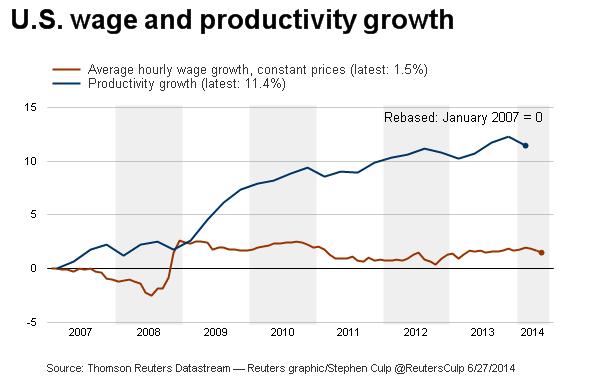
US wage and productivity growth
The Pitchforks Are Coming… For Us Plutocrats
How Ayn Rand became the new right's version of Marx
The United States of Cruelty
A Secret Plan to Close Social Security’s Offices and Outsource Its Work
Blood Banking
Stay Classy: Class is not the universal solvent that does away with all identity
The Only Government I Know: How the Criminal Justice System Degrades Democratic Citizenship
Other
The Scary Reason Some Men Like Guns Better Than Women
One Law for Abortion and One Law for Banks
Anti-feminists are outraged that feminists argue you should only kiss people who are kissing you back
You are not Google’s customer
Gabriel Kolko’s Unfinished Revolution
what’s wrong with paul krugman’s philosophy of economics?
Thelen on the prospects for egalitarian capitalism
US wage and productivity growth
The Pitchforks Are Coming… For Us Plutocrats
How Ayn Rand became the new right's version of Marx
The United States of Cruelty
A Secret Plan to Close Social Security’s Offices and Outsource Its Work
Blood Banking
Stay Classy: Class is not the universal solvent that does away with all identity
The Only Government I Know: How the Criminal Justice System Degrades Democratic Citizenship
Other
The Scary Reason Some Men Like Guns Better Than Women
One Law for Abortion and One Law for Banks
Anti-feminists are outraged that feminists argue you should only kiss people who are kissing you back
Sunday, June 22, 2014
Links June 22, 2014
Political Economy
The Cost of Contemporary Policing
A Review of Alice Goffman’s On the Run
How Hayek Helped the Worst Get to the Top in Economics and as CEOs
The Iraq Delusion Revisited
The Lack of Major Wars May Be Hurting Economic Growth
Bureaucracy and Solidarity: An Interview with Staughton Lynd: What strategies can reverse the labor movement’s decline?
Thoughts on Robert Skidelsky’s Manifesto for the Reform of the Anglo-Saxon Economics Curriculum
Rent, Rent Control, and Economic Rents
Guns made civil rights possible: Breaking down the myth of nonviolent change: A crucial part of the struggle's been forgotten: how armed self-defense protected activists from white supremacists
The Disruption Machine: What the gospel of innovation gets wrong.
Gentrification’s Racial Arbitrage
Other
Philosophy is a Bunch of Empty Ideas: Interview with Peter Unger
5 Everyday Objects Scientists MacGyvered Into Huge Advances
The Cost of Contemporary Policing
A Review of Alice Goffman’s On the Run
How Hayek Helped the Worst Get to the Top in Economics and as CEOs
The Iraq Delusion Revisited
The Lack of Major Wars May Be Hurting Economic Growth
Bureaucracy and Solidarity: An Interview with Staughton Lynd: What strategies can reverse the labor movement’s decline?
Thoughts on Robert Skidelsky’s Manifesto for the Reform of the Anglo-Saxon Economics Curriculum
Rent, Rent Control, and Economic Rents
Guns made civil rights possible: Breaking down the myth of nonviolent change: A crucial part of the struggle's been forgotten: how armed self-defense protected activists from white supremacists
The Disruption Machine: What the gospel of innovation gets wrong.
Gentrification’s Racial Arbitrage
Other
Philosophy is a Bunch of Empty Ideas: Interview with Peter Unger
5 Everyday Objects Scientists MacGyvered Into Huge Advances
Sunday, June 15, 2014
Links June 15 2014
Political Economy
The internet is made of cats – and you can blame economists
Savage capitalism is back – and it will not tame itself
Spotlight on the financial sector did make apparent just how bizarrely skewed our economy is in terms of who gets rewarded: David Graeber explains why the more your job helps others, the less you get paid
For Jewish groups, a stand-off between open debate and support of Israel
Unwitting tea party folk do the bidding of big business
Other
The Tortured Rise of the All-American Bro (push through past the intro)
5 Uncomfortable Truths Behind the Men's Rights Movement
How the woman got her period
The internet is made of cats – and you can blame economists
Savage capitalism is back – and it will not tame itself
Spotlight on the financial sector did make apparent just how bizarrely skewed our economy is in terms of who gets rewarded: David Graeber explains why the more your job helps others, the less you get paid
For Jewish groups, a stand-off between open debate and support of Israel
Unwitting tea party folk do the bidding of big business
Other
The Tortured Rise of the All-American Bro (push through past the intro)
5 Uncomfortable Truths Behind the Men's Rights Movement
How the woman got her period
Tuesday, June 10, 2014
Micro- and macroeconomics
A commenter has asked me why we study microeconomics and macroeconomics* separately. It's necessary but not sufficient to simply say that microeconomics is the study of households, and firms**, and macroeconomics is the study of the national economy as a whole. After all, while physicists do specialize, we don't have "microphysics" and "macrophysics" as separate disciplines, even though physicists study everything from quarks to planets to galaxy clusters to the whole universe. It's all just physics.
*There are actually three levels of economics: micro, macro, and international economics.
**Households and firms usually are not internally organized by markets, although there are many economists who use economic techniques to study intra-household and intra-firm behavior.
Economics is different because economics is more complex (has more independent "moving parts") than physics, and has more feedback mechanisms. Specifically, although they are connected, there are features about the economy as a whole (macro) that have such a radically different character than features about the economy of individuals (micro) that we must think about them in radically different ways. A more apt analogy is the difference between biology (the study of individual species and organisms) and ecology (how organisms interact). Obviously, ecology is intimately linked to the biology of the species, and in some sense emerges from that biology, but the conceptual tools are very different between the two fields.
Economics in general is the study of trade-offs. When someone has to give something up to get something else, economists spring into action! The fundamental difference, therefore, between micro and macro is what is being traded off, and how those trade-offs are measured and conceptualized. Fundamentally, microeconomics is about relations between actors in a national economy, but there is nothing for a national economy to be relative to. (Again, international economics complicates this framework a bit, but by and large, most large national economies such as the United States can be treated as closed systems with a small correction for net imports and exports.)
The biggest difference is flow. Micro is linear: a household or a firm has an income on one side and an expenditure on the other side, with stuff coming in or out in the opposite direction. In contrast, macro is circular: money circulates between households and firms, with labor and stuff circulating in the opposite direction.
Another difference is money. A household or firm can run out of money; the national economy cannot run out of money. While some individual household or firm might not have money (savings or income), and is therefore limited in what they can consume, the money is always somewhere in the national economy. In micro we study how households and firms allocate their money, how they make choices constrained by the money that they have (savings) and that they expect (income). In macro, however, because the money is always somewhere, and the total amount of money is (more-or-less) constant, so we don't conceptualize trade-offs as being constrained by money. Instead, macroeconomics is concerned with the total real productivity and consumption of the economy. Indeed, there is presently a debate between classical/neoclassical macroeconomists, who think that money doesn't matter at all (it's just a lubricant; you have to have some, but adding extra lubricant won't make your engine any more powerful), Keynesians (classical, neo- and paleo-), who think that money does matter (prices not as much), and monetarists, who also think that money and prices matter, but in a different way than Keynesians. In contrast, there are exactly zero microeconomists who think that the money a household or firm has doesn't matter.
Similarly, individual households want to accumulate money. They want to optimize their money income and/or their profit. In macro, however, we can't make a profit; profit is always relative; the net profit for the economy as a whole is exactly equal (as a boring accounting identity) to whatever new money we have put into the system in one way or another, i.e. mining gold and silver or printing dollar bills.
Another difference is what is being traded off. In micro, we trade off between production or consumption of different items. I can buy better food, or I can pay more in rent. I can choose between oranges and apples. A household can work more or have more leisure. A firm can produce more or fewer oranges or apples, and it can choose between more capital (machines) or more labor. In macro, however, all there is is one big lump of everything; generally, we don't worry about the trade-off between everything and nothing (nobody wants nothing). Instead, the big trade-off is between consumption, producing stuff we'll use today, and investment, producing stuff that will produce stuff we'll use tomorrow. In macro, we also think about trade-offs between the the large-scale entities in an economy: all households (and sometimes all working households vs. all investing households), all private productive firms, all financial firms, and, of course, the government.
There is also a controversy in macro as to whether the economy as a whole can fail even if all the parts are working correctly. Classical and neoclassical economists say that if all the parts (households and firms) are working, then the whole economy is working by definition; if you don't like how the whole economy is working, then one or more of the parts are failing. For example, the classical economists attribute the Great Depression (and the current Lesser Depression) to a combination of malinvestment (we built too many factories to make stuff people didn't want), structural unemployment (workers didn't have the skills that firms wanted), irrationality (workers refusing to accept lower money wages even though prices had fallen, so their real wage had increased), and government misregulation (in the extreme, some assert that all government regulation except enforcing contracts is misregulation). Monetarists lean towards the classical view in this regard: they attribute problems in the whole economy to failures of the banking system or government regulation of the banking system. In A Monetary History of the United States, Milton Friedman and Anna Schwartz make a compelling case that errors by the Federal Reserve in regulating and supporting the private banking system at least deepened and may have caused the Great Depression. In contrast, Keynesians assert that all the parts of the economy can be working correctly in micro terms, but the economy as a whole can still fail, measured by cyclical or involuntary unemployment.
Again, in contrast, there are exactly zero microeconomists who claim that all the parts of a firm can be working correctly, it has sufficient capital and labor in the optimal proportion, it has a market for its correctly-priced product, and its workforce and administration are competent, and yet the firm can be unprofitable.
So, basically, the individual household and firm are conceptually very different from all the households and firms in a national economy. Therefore, we divide up economics into micro and macro.
*There are actually three levels of economics: micro, macro, and international economics.
**Households and firms usually are not internally organized by markets, although there are many economists who use economic techniques to study intra-household and intra-firm behavior.
Economics is different because economics is more complex (has more independent "moving parts") than physics, and has more feedback mechanisms. Specifically, although they are connected, there are features about the economy as a whole (macro) that have such a radically different character than features about the economy of individuals (micro) that we must think about them in radically different ways. A more apt analogy is the difference between biology (the study of individual species and organisms) and ecology (how organisms interact). Obviously, ecology is intimately linked to the biology of the species, and in some sense emerges from that biology, but the conceptual tools are very different between the two fields.
Economics in general is the study of trade-offs. When someone has to give something up to get something else, economists spring into action! The fundamental difference, therefore, between micro and macro is what is being traded off, and how those trade-offs are measured and conceptualized. Fundamentally, microeconomics is about relations between actors in a national economy, but there is nothing for a national economy to be relative to. (Again, international economics complicates this framework a bit, but by and large, most large national economies such as the United States can be treated as closed systems with a small correction for net imports and exports.)
The biggest difference is flow. Micro is linear: a household or a firm has an income on one side and an expenditure on the other side, with stuff coming in or out in the opposite direction. In contrast, macro is circular: money circulates between households and firms, with labor and stuff circulating in the opposite direction.
Another difference is money. A household or firm can run out of money; the national economy cannot run out of money. While some individual household or firm might not have money (savings or income), and is therefore limited in what they can consume, the money is always somewhere in the national economy. In micro we study how households and firms allocate their money, how they make choices constrained by the money that they have (savings) and that they expect (income). In macro, however, because the money is always somewhere, and the total amount of money is (more-or-less) constant, so we don't conceptualize trade-offs as being constrained by money. Instead, macroeconomics is concerned with the total real productivity and consumption of the economy. Indeed, there is presently a debate between classical/neoclassical macroeconomists, who think that money doesn't matter at all (it's just a lubricant; you have to have some, but adding extra lubricant won't make your engine any more powerful), Keynesians (classical, neo- and paleo-), who think that money does matter (prices not as much), and monetarists, who also think that money and prices matter, but in a different way than Keynesians. In contrast, there are exactly zero microeconomists who think that the money a household or firm has doesn't matter.
Similarly, individual households want to accumulate money. They want to optimize their money income and/or their profit. In macro, however, we can't make a profit; profit is always relative; the net profit for the economy as a whole is exactly equal (as a boring accounting identity) to whatever new money we have put into the system in one way or another, i.e. mining gold and silver or printing dollar bills.
Another difference is what is being traded off. In micro, we trade off between production or consumption of different items. I can buy better food, or I can pay more in rent. I can choose between oranges and apples. A household can work more or have more leisure. A firm can produce more or fewer oranges or apples, and it can choose between more capital (machines) or more labor. In macro, however, all there is is one big lump of everything; generally, we don't worry about the trade-off between everything and nothing (nobody wants nothing). Instead, the big trade-off is between consumption, producing stuff we'll use today, and investment, producing stuff that will produce stuff we'll use tomorrow. In macro, we also think about trade-offs between the the large-scale entities in an economy: all households (and sometimes all working households vs. all investing households), all private productive firms, all financial firms, and, of course, the government.
There is also a controversy in macro as to whether the economy as a whole can fail even if all the parts are working correctly. Classical and neoclassical economists say that if all the parts (households and firms) are working, then the whole economy is working by definition; if you don't like how the whole economy is working, then one or more of the parts are failing. For example, the classical economists attribute the Great Depression (and the current Lesser Depression) to a combination of malinvestment (we built too many factories to make stuff people didn't want), structural unemployment (workers didn't have the skills that firms wanted), irrationality (workers refusing to accept lower money wages even though prices had fallen, so their real wage had increased), and government misregulation (in the extreme, some assert that all government regulation except enforcing contracts is misregulation). Monetarists lean towards the classical view in this regard: they attribute problems in the whole economy to failures of the banking system or government regulation of the banking system. In A Monetary History of the United States, Milton Friedman and Anna Schwartz make a compelling case that errors by the Federal Reserve in regulating and supporting the private banking system at least deepened and may have caused the Great Depression. In contrast, Keynesians assert that all the parts of the economy can be working correctly in micro terms, but the economy as a whole can still fail, measured by cyclical or involuntary unemployment.
Again, in contrast, there are exactly zero microeconomists who claim that all the parts of a firm can be working correctly, it has sufficient capital and labor in the optimal proportion, it has a market for its correctly-priced product, and its workforce and administration are competent, and yet the firm can be unprofitable.
So, basically, the individual household and firm are conceptually very different from all the households and firms in a national economy. Therefore, we divide up economics into micro and macro.
Sunday, June 01, 2014
In defense of "Do What You Love"
Yes, you "should"* do what you love, as your career and your profession. True, not everyone gets to do what they love, but that is a social failure, not a personal one. Marx's chief complaint against capitalism is that even when it's working "perfectly," it alienates workers from both the product and from the process of production. Both the product and the work are no longer valuable in their own right; they are just an instrument for the capitalist to accumulate more money, and for the worker to earn wages to consume. A communist society, as Marx declares in Gotha, can occur only after, among other things, "labor has become not only a means of life but life's prime want." The problem is not that the workers' sacrifice is not sufficiently rewarded, the problem is the sacrifice itself. Instead, We should strive for a society where everyone can do what they love. In the meantime, those who are privileged enough to actually be able to do what they love have no cause to feel guilty or ashamed for just doing so.
If you'll forgive using normative language to talk about just doing what you want.
Doing what you love is a positive privilege: it is something that everyone should have, but only a few actually do have. It is not a negative privilege: it is not something, such as the ability to break the law with impunity that no one should have but some do, such as the ability to break the law with impunity. Similarly it is not, at least in the ideal case, something, such as "leadership," that if a few have it, others are necessarily excluded. Doing what you love is like being able to go almost anywhere without fear: as a white man, I have this privilege; women and people of color do not. The way to correct this privilege is not to force everyone to live in fear, but to eliminate the fear that those without the privilege have to live with. The cure for any positive privilege is not to condemn the privilege, but to extend it to everyone.
Positive privilege becomes problematic when people attach other attitudes to it. I have been able to do what I love my whole life, and I have mostly been relatively well-paid for doing so. But I have not had this privilege because I am extraordinary or in any way better than anyone else; I was just lucky. My privilege is not evidence of my innate superiority, either of ability or character. I was born white, male, American; I was well-fed, well-educated, and socialized with middle-class manners; I had a talent and love for a field, computer programming, that for a long time was highly in demand.
Not everyone agrees. In In In the Name of Love, Miya Tokumitsu believes that doing what you love is selfish and exploitative. But Tokumitsu is long on condemnation and short on quality analysis. For example, she holds up Steve Jobs as an epitome of doing what you love. She quotes Jobs' 2005 Stanford graduation speech:
Tokumitsu also assumes that only the elite's "creative, intellectual, socially prestigious" work can possibly be lovable. All else is "repetitive, unintellectual, undistinguished." But this characterization only betrays Tokumitsu's ivory tower elitism. (Tokumitsu holds a Ph.D. in art history, but I'm unable to determine his or her own job; dollars to donuts it's neither repetitive nor unintellectual.) There's no intrinsic reason that any human labor must be repetitive or unintellectual, nor any intrinsic reason why creative, intellectual work should be valued more than any other: the "antithesis between mental and physical labor" (Gotha) is not, according to Marx, intrinsic, but an artifact of capitalism. I know construction workers who love construction, plumbers who love plumbing; I can even imagine factory work, properly constructed, can be rewarding and fulfilling. Perhaps there are some jobs that are unlovable (cleaning other people's toilets comes to mind), but those jobs should not be glorified; they should either be done by machines, shared democratically rather than economically, or at least paid extremely well. I would happily be a janitor for $100,000 per year, and I would clean toilets with love.
In A Life Beyond ‘Do What You Love’, Gordon Marino offers an explicitly Kantian critique. According to Marino, doing what we love is only one dimension in our thinking on our choice of work. Marino references Martin Luther King's metaphor of length, breadth and depth: our own desires, service to the community, and service to the "transcendent." It would be a mistake, argues Marino, to accept as "faith that my likes and dislikes or our sense of meaning alone should decide what I do [emphasis added]." But Marino's analysis doesn't work. First, "service to the community" is neither opposite nor orthogonal but part of doing what you love. We are inherently social; we are not social because of some external moral norm. I presently work as a writing tutor not because I love reading the work of unskilled writers, but because I love helping hundreds of writers every year become more skilled, more sophisticated, and more expressive. What I love is service to the community. And (with apologies to Dr. King) the notion of service to the "transcendent" is nonsensical. The only coherent, existent thing that can demand "obedience and the willingness to submerge and remold our desires" is the ruling class du jour.
Yes, it is possible to trivialize and coopt "do what you love." Capitalism is notable for trivializing and coopting everything. But just because capitalism has trivialized and coopted marriage and family, as Marx and Engels observe in the Communist Manifesto, does not mean that we should stop partnering and having children. It is notable that both Tokumitsu and Marino do not offer any evidence that popular culture actually trivializes the idea of doing what you love: it is the concept itself they charge is trivial hedonism.
But it is a mistake to interpret "do what you love" as mere hedonism, as just the expression of "likes and disklikes." The ethos is do what you love (and love what you do), not do what you like. To love something is to dedicate everything you have and more to it, and to do so because you want to. And love is to cherish everything, not just the pleasant bits. To love something requires the highest discipline. Love requires sacrifice, but it is the sacrifice of the lower to the higher. But it is your own higher and lower, not the judgment of some self-styled philosophical or theological authority.
Marino interprets (fairly, I think) Tokumitsu's essay as saying that "the 'do what you love' ethos . . . degrades work that is not done from love." But it's true: work, indeed anything, not done from love really is degrading. No, we should not ignore or erase those who cannot do what they love, but neither should we glorify doing what you hate. That some must do what they hate should shock our conscience, should arouse our righteous indignation. Yes, we must sometimes do things because they must be done, however much we may hate it, but that is a problem to be solved, not a condition to be excused, much less glorified. Whether man or nature enslaves you, to dedicate anything, much less everything, to what you hate is slavery.
We need to build a society where everyone can do what they love, a society where labor is "life's prime want." As much as capitalism tries to trivialize it, "do what you love" is fundamentally subversive, even revolutionary. It is the antithesis of Christian slave morality, work for God (i.e. His representatives in the ruling class); it is the antithesis of work to live. It is the highest ideal and the liberation of all humanity.
If you'll forgive using normative language to talk about just doing what you want.
Doing what you love is a positive privilege: it is something that everyone should have, but only a few actually do have. It is not a negative privilege: it is not something, such as the ability to break the law with impunity that no one should have but some do, such as the ability to break the law with impunity. Similarly it is not, at least in the ideal case, something, such as "leadership," that if a few have it, others are necessarily excluded. Doing what you love is like being able to go almost anywhere without fear: as a white man, I have this privilege; women and people of color do not. The way to correct this privilege is not to force everyone to live in fear, but to eliminate the fear that those without the privilege have to live with. The cure for any positive privilege is not to condemn the privilege, but to extend it to everyone.
Positive privilege becomes problematic when people attach other attitudes to it. I have been able to do what I love my whole life, and I have mostly been relatively well-paid for doing so. But I have not had this privilege because I am extraordinary or in any way better than anyone else; I was just lucky. My privilege is not evidence of my innate superiority, either of ability or character. I was born white, male, American; I was well-fed, well-educated, and socialized with middle-class manners; I had a talent and love for a field, computer programming, that for a long time was highly in demand.
Not everyone agrees. In In In the Name of Love, Miya Tokumitsu believes that doing what you love is selfish and exploitative. But Tokumitsu is long on condemnation and short on quality analysis. For example, she holds up Steve Jobs as an epitome of doing what you love. She quotes Jobs' 2005 Stanford graduation speech:
You’ve got to find what you love. And that is as true for your work as it is for your lovers. Your work is going to fill a large part of your life, and the only way to be truly satisfied is to do what you believe is great work. And the only way to do great work is to love what you do.According to Tokumitsu, this quotation indicates that Jobs was "portraying Apple as a labor of his individual love," which "elided the labor of untold thousands in Apple’s factories." But there's a lot of distance between Jobs' words and Tokumitsu's interpretation. Maybe other evidence shows that Jobs really does, as Tokumitsu puts it, violently erase the contributions of thousands of engineers, designers, and factory workers to making Jobs' love a reality, but there's no evidence that Jobs doing what he loved, or framing his own work as a labor of love, is the cause of that violent erasure.
Tokumitsu also assumes that only the elite's "creative, intellectual, socially prestigious" work can possibly be lovable. All else is "repetitive, unintellectual, undistinguished." But this characterization only betrays Tokumitsu's ivory tower elitism. (Tokumitsu holds a Ph.D. in art history, but I'm unable to determine his or her own job; dollars to donuts it's neither repetitive nor unintellectual.) There's no intrinsic reason that any human labor must be repetitive or unintellectual, nor any intrinsic reason why creative, intellectual work should be valued more than any other: the "antithesis between mental and physical labor" (Gotha) is not, according to Marx, intrinsic, but an artifact of capitalism. I know construction workers who love construction, plumbers who love plumbing; I can even imagine factory work, properly constructed, can be rewarding and fulfilling. Perhaps there are some jobs that are unlovable (cleaning other people's toilets comes to mind), but those jobs should not be glorified; they should either be done by machines, shared democratically rather than economically, or at least paid extremely well. I would happily be a janitor for $100,000 per year, and I would clean toilets with love.
In A Life Beyond ‘Do What You Love’, Gordon Marino offers an explicitly Kantian critique. According to Marino, doing what we love is only one dimension in our thinking on our choice of work. Marino references Martin Luther King's metaphor of length, breadth and depth: our own desires, service to the community, and service to the "transcendent." It would be a mistake, argues Marino, to accept as "faith that my likes and dislikes or our sense of meaning alone should decide what I do [emphasis added]." But Marino's analysis doesn't work. First, "service to the community" is neither opposite nor orthogonal but part of doing what you love. We are inherently social; we are not social because of some external moral norm. I presently work as a writing tutor not because I love reading the work of unskilled writers, but because I love helping hundreds of writers every year become more skilled, more sophisticated, and more expressive. What I love is service to the community. And (with apologies to Dr. King) the notion of service to the "transcendent" is nonsensical. The only coherent, existent thing that can demand "obedience and the willingness to submerge and remold our desires" is the ruling class du jour.
Yes, it is possible to trivialize and coopt "do what you love." Capitalism is notable for trivializing and coopting everything. But just because capitalism has trivialized and coopted marriage and family, as Marx and Engels observe in the Communist Manifesto, does not mean that we should stop partnering and having children. It is notable that both Tokumitsu and Marino do not offer any evidence that popular culture actually trivializes the idea of doing what you love: it is the concept itself they charge is trivial hedonism.
But it is a mistake to interpret "do what you love" as mere hedonism, as just the expression of "likes and disklikes." The ethos is do what you love (and love what you do), not do what you like. To love something is to dedicate everything you have and more to it, and to do so because you want to. And love is to cherish everything, not just the pleasant bits. To love something requires the highest discipline. Love requires sacrifice, but it is the sacrifice of the lower to the higher. But it is your own higher and lower, not the judgment of some self-styled philosophical or theological authority.
Marino interprets (fairly, I think) Tokumitsu's essay as saying that "the 'do what you love' ethos . . . degrades work that is not done from love." But it's true: work, indeed anything, not done from love really is degrading. No, we should not ignore or erase those who cannot do what they love, but neither should we glorify doing what you hate. That some must do what they hate should shock our conscience, should arouse our righteous indignation. Yes, we must sometimes do things because they must be done, however much we may hate it, but that is a problem to be solved, not a condition to be excused, much less glorified. Whether man or nature enslaves you, to dedicate anything, much less everything, to what you hate is slavery.
We need to build a society where everyone can do what they love, a society where labor is "life's prime want." As much as capitalism tries to trivialize it, "do what you love" is fundamentally subversive, even revolutionary. It is the antithesis of Christian slave morality, work for God (i.e. His representatives in the ruling class); it is the antithesis of work to live. It is the highest ideal and the liberation of all humanity.
Subscribe to:
Posts (Atom)